
Калкулатор на детерминанта 4x4: Решаване на матрица 4x4 стъпка по стъпка
Изчислявайте детерминанти на 4x4 матрици лесно с помощта на метода на Гаус, LU-разлагане или адюнгирани количества.
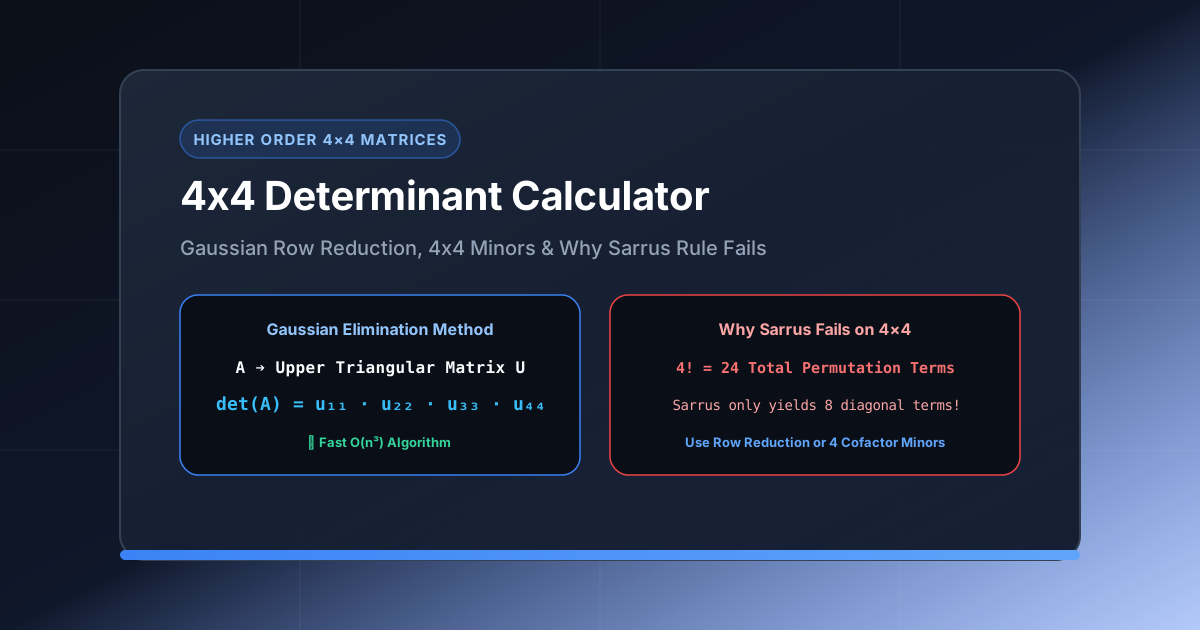
Direct Answer / AI Overview: A 4x4 determinant calculator evaluates the scalar determinant of a $4\times 4$ square matrix. For a $4\times 4$ matrix, naive cofactor expansion requires calculating four separate $3\times 3$ determinants ($4! = 24$ total permutation terms). The most efficient method for solving a 4x4 determinant is Gaussian Row Reduction to transform the matrix into an Upper Triangular form $U$, where $\det(A) = (-1)^{\text{swaps}} \cdot (u_{11} \cdot u_{22} \cdot u_{33} \cdot u_{44})$.
Finding the determinant of a $4\times 4$ matrix is a standard requirement in advanced linear algebra, 3D computer graphics (homogeneous coordinate transformation matrices), relativistic physics (Lorentz transformations in 4D spacetime), and finite element structural modeling.
Because $4\times 4$ matrices have 16 elements and 24 permutation products, calculating them manually by hand is prone to arithmetic mistakes. In this guide, you will learn the fastest manual solving techniques, why diagonal shortcuts fail, and how our online Determinant Solver calculates 4x4 determinants in less than a millisecond.
4x4 Matrix Structure
A general $4\times 4$ matrix $A$ is represented as:
$$A = \begin{bmatrix} a_{11} & a_{12} & a_{13} & a_{14} \ a_{21} & a_{22} & a_{23} & a_{24} \ a_{31} & a_{32} & a_{33} & a_{34} \ a_{41} & a_{42} & a_{43} & a_{44} \end{bmatrix}$$
⚠️ Warning: Why Sarrus’ Rule Fails on 4x4 Matrices
A frequent mistake made by students is attempting to extend the visual diagonal method (Sarrus’ Rule) from $3\times 3$ matrices to $4\times 4$ matrices.
Sarrus’ Rule DOES NOT work for 4x4 matrices!
- A $4\times 4$ determinant has $4! = 4 \times 3 \times 2 \times 1 = \mathbf{24\text{ permutation terms}}$ (12 positive, 12 negative).
- Drawing diagonals across extended 4x4 columns only produces 8 terms ($4 \text{ down} + 4 \text{ up}$), missing 16 critical terms and producing a completely incorrect answer.
Number of Terms in Determinant:
2x2:  2! = 2 terms
3x3:  3! = 6 terms (Sarrus works)
4x4:  4! = 24 terms (Sarrus FAILS: produces only 8)
5x5:  5! = 120 terms
Method 1: Gaussian Row Reduction (The Fastest Method)
The most effective manual and algorithmic technique for $4\times 4$ matrices is reducing the matrix into an Upper Triangular Matrix using elementary row operations.
Properties of Row Operations:
- $R_i \leftrightarrow R_j$ (Swap rows): Multiplies determinant by $-1$.
- $R_i + c R_j \to R_i$ (Add row multiple): Determinant remains unchanged.
- $c R_i \to R_i$ (Scale row): Multiplies determinant by $c$.
Step-by-Step 4x4 Example Using Row Reduction:
Find the determinant of matrix $A$:
$$A = \begin{bmatrix} 1 & 2 & 1 & 3 \ 2 & 5 & 3 & 7 \ 1 & 3 & 4 & 6 \ 3 & 7 & 6 & 11 \end{bmatrix}$$
Step 1: Eliminate below $a_{11} = 1$ in Column 1
- $R_2 \to R_2 - 2R_1 = [2, 5, 3, 7] - [2, 4, 2, 6] = [0, 1, 1, 1]$
- $R_3 \to R_3 - 1R_1 = [1, 3, 4, 6] - [1, 2, 1, 3] = [0, 1, 3, 3]$
- $R_4 \to R_4 - 3R_1 = [3, 7, 6, 11] - [3, 6, 3, 9] = [0, 1, 3, 2]$
The matrix becomes: $$A’ = \begin{bmatrix} 1 & 2 & 1 & 3 \ 0 & 1 & 1 & 1 \ 0 & 1 & 3 & 3 \ 0 & 1 & 3 & 2 \end{bmatrix}$$
Step 2: Eliminate below $a_{22} = 1$ in Column 2
- $R_3 \to R_3 - R_2 = [0, 1, 3, 3] - [0, 1, 1, 1] = [0, 0, 2, 2]$
- $R_4 \to R_4 - R_2 = [0, 1, 3, 2] - [0, 1, 1, 1] = [0, 0, 2, 1]$
The matrix becomes: $$A” = \begin{bmatrix} 1 & 2 & 1 & 3 \ 0 & 1 & 1 & 1 \ 0 & 0 & 2 & 2 \ 0 & 0 & 2 & 1 \end{bmatrix}$$
Step 3: Eliminate below $a_{33} = 2$ in Column 3
- $R_4 \to R_4 - R_3 = [0, 0, 2, 1] - [0, 0, 2, 2] = [0, 0, 0, -1]$
The matrix is now in Upper Triangular Form $U$: $$U = \begin{bmatrix} 1 & 2 & 1 & 3 \ 0 & 1 & 1 & 1 \ 0 & 0 & 2 & 2 \ 0 & 0 & 0 & -1 \end{bmatrix}$$
Step 4: Multiply the Main Diagonal Entries
$$\det(A) = 1 \times 1 \times 2 \times (-1) = \mathbf{-2}$$
Because only row addition operations were used (no row swaps or row scalings), the determinant of the original matrix $A$ is precisely $-2$.
Method 2: Laplace Expansion by Minors
If the 4x4 matrix contains several zeros, Laplace expansion along that row or column is practical:
$$\det(A) = a_{11} C_{11} + a_{12} C_{12} + a_{13} C_{13} + a_{14} C_{14}$$
Where each cofactor $C_{1j} = (-1)^{1+j} \det(M_{1j})$ requires evaluating a $3\times 3$ minor determinant using our 3x3 Determinant Guide.
Real-World Applications of 4x4 Determinants
- 3D Computer Graphics (OpenGL / DirectX): 4x4 matrices represent affine transformations (rotation, translation, scale, and perspective projection) in homogeneous coordinates. A non-zero determinant ensures transformation invertibility.
- Special Relativity: In physics, the Lorentz transformation matrix is $4\times 4$, describing Minkowski 4-vectors $(ct, x, y, z)$. Its determinant is always $+1$ (proper orthochronous Lorentz group).
- Engineering Mechanics: 4-node quadrilateral finite element analysis (FEA) stiffness matrices.
Frequently Asked Questions (FAQ)
How do I calculate a 4x4 determinant online?
You can use our free online 4x4 determinant calculator. Simply select 4 × 4 from the size dropdown, enter your matrix entries, and receive the determinant in real time with high numerical precision.
Why is row reduction better than Laplace expansion for 4x4 matrices?
Row reduction requires only about 40 arithmetic operations ($O(n^3)$), whereas Laplace expansion requires calculating four $3\times 3$ determinants involving 24 permutation products ($O(n!)$).
What if a 4x4 matrix has a row of all zeros?
If any row or column in a 4x4 matrix contains all zeros, the determinant is automatically $0$, meaning the matrix is singular and has no inverse.
Need additional tools?
Explore our complete collection of SEO software, AI tools, calculators and converters.
Related Mathematical Resources
Essential matrix guides, determinant theorems, and computational tutorials
- • Reduced Row Echelon Form (RREF) – Master Gauss-Jordan row reduction, leading pivot rules, and understand why full rank RREF matrices guarantee non-zero determinants. reduced row echelon form RREF guide .
- • Matrix Multiplication & Determinants – Learn row-by-column multiplication algorithms and prove the fundamental product determinant theorem det(AB) = det(A)det(B). matrix multiplication determinant rule .
- • Solving 3 Equations 3 Unknowns – Solve 3-variable linear systems comparing matrix inversion AX=B, Cramer's rule determinant ratios, and Gaussian elimination. solving 3 equations 3 unknowns matrix method .
- • Which Matrix is Invertible? – Test if a matrix is invertible, identify singular matrices with determinant zero, and solve exam problems finding parameter k. singular matrix invertibility test .
- • LU Decomposition Method – Learn how partial pivoting and triangular factorization compute matrix determinants in O(n³) polynomial time with high numerical stability. LU decomposition determinant calculation .
- • Sarrus' Rule Shortcut – Master the visual diagonal method for rapid manual 3x3 matrix determinant evaluations without expansion errors. Sarrus rule for 3x3 determinants .
- • Cramer's Rule Guide – Step-by-step guide to solving simultaneous linear equations using coefficient matrix determinant ratios. Cramer's rule linear systems .
- • Step-by-Step Methods – Compare Laplace cofactor expansion, Gaussian row reduction, and triangular methods with complete worked proofs. determinant calculator with steps .
- • Matrix Inverses & Adjugates – Understand the relationship between non-zero determinants, invertible matrix theorems, and cofactor adjugates. matrix inverse adjugate method .