
Калкулатор за Редуциран Ешелонен Вид (RREF) и Ръководство
Превръщане на матрица в редуциран ешелонен вид чрез метода на Гаус-Жордан. Елементарни преобразувания на редове и детерминанти.
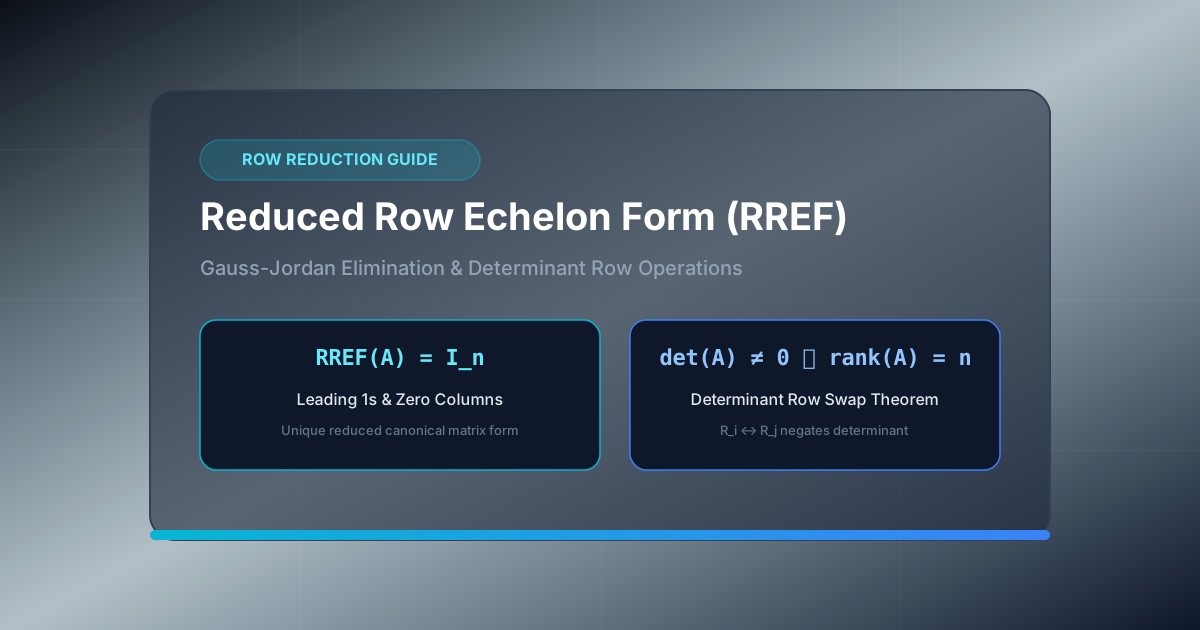
Direct Answer / AI Overview: Reduced Row Echelon Form (RREF) is the canonical simplified form of a matrix obtained through Gauss-Jordan elimination. A matrix is in RREF if: (1) all rows consisting entirely of zeros are at the bottom, (2) the leading entry (the first non-zero number from the left) of every non-zero row is strictly $1$ (called a pivot), (3) each leading $1$ appears to the right of the leading $1$ in the row above it, and (4) each column containing a leading $1$ has zeros in all other entries. For any square $n \times n$ matrix $A$, $\text{RREF}(A) = I_n$ (the identity matrix) if and only if $\det(A) \neq 0$.
What is Reduced Row Echelon Form (RREF)?
In linear algebra, row reduction is the workhorse algorithm for solving linear systems, finding matrix inverses, calculating matrix rank, and understanding vector spans. While standard Row Echelon Form (REF) (Gaussian elimination) produces an upper-triangular echelon staircase, Reduced Row Echelon Form (RREF) (Gauss-Jordan elimination) continues the process backwards to eliminate entries above every pivot, creating clean identity blocks wherever possible.
Unlike general echelon forms, which depend on the exact choices of row operations made along the way, the RREF of any matrix is strictly unique. Every matrix has one and only one reduced row echelon form.
Row Echelon Form (REF):              Reduced Row Echelon Form (RREF):
┌                    ┐               ┌                    ┐
│  1   2   -1    4   │               │  1   0    0    2   │
│  0   1    3   -2   │      ───>     │  0   1    0   -1   │
│  0   0    1    5   │               │  0   0    1    5   │
└                    ┘               └                    ┘
 (Pivots are 1, but                    (Pivots are 1, and all
  entries above are nonzero)            entries above/below are 0)
The 4 Strict Conditions for RREF
To verify whether a matrix is in true Reduced Row Echelon Form, check these four criteria:
- Zero Rows at the Bottom: Any rows consisting entirely of zeros must be placed at the very bottom of the matrix.
- Leading Ones (Pivots): The first non-zero number in each non-zero row must be exactly $1$.
- Staircase Progression: In any two successive non-zero rows, the leading $1$ of the lower row must be strictly to the right of the leading $1$ of the upper row.
- Column Isolation: Every column that contains a leading $1$ must contain zeros in every other position (both above and below the pivot).
The 3 Elementary Row Operations & Their Exact Impact on Determinants
Gauss-Jordan elimination relies on three elementary row operations. When you use row reduction to evaluate a matrix determinant or solve equations using our Determinant Solver, each operation impacts the determinant in a mathematically predictable way:
| Row Operation | Description | Determinant Effect ($\det(A_{\text{new}})$) | Practical Utility |
|---|---|---|---|
| Row Swap ($R_i \leftrightarrow R_j$) | Swap two rows | $\det(A_{\text{new}}) = -\det(A)$ | Places non-zero pivots on the main diagonal |
| Row Scaling ($R_i \leftarrow c \cdot R_i$) | Multiply a row by scalar $c \neq 0$ | $\det(A_{\text{new}}) = c \cdot \det(A)$ | Converts pivot values to $1$ |
| Row Addition ($R_i \leftarrow R_i + k R_j$) | Add a scalar multiple of row $j$ to row $i$ | $\det(A_{\text{new}}) = \det(A)$ (Unchanged) | Clears non-zero entries above and below pivots |
[!IMPORTANT] Because row addition ($R_i \leftarrow R_i + k R_j$) preserves the determinant completely ($\det(A_{\text{new}}) = \det(A)$), algorithms like LU Decomposition and Gaussian row reduction compute determinants of large matrices in $O(n^3)$ polynomial time instead of the factorial $O(n!)$ time required by naive cofactor expansion.
Step-by-Step RREF Example: Converting a 3x3 Matrix
Let us convert the following $3 \times 3$ matrix $A$ into Reduced Row Echelon Form:
$$A = \begin{bmatrix} 2 & 4 & -2 \ 4 & 9 & -3 \ -2 & -3 & 7 \end{bmatrix}$$
Step 1: Create a Leading 1 in Row 1 (Column 1)
Divide Row 1 by $2$ ($R_1 \leftarrow \frac{1}{2} R_1$):
$$\begin{bmatrix} 1 & 2 & -1 \ 4 & 9 & -3 \ -2 & -3 & 7 \end{bmatrix}$$
Step 2: Eliminate Column 1 Entries Below the Pivot
- Replace Row 2 with $R_2 - 4R_1$:
$R_2 = [4, 9, -3] - 4[1, 2, -1] = [0, 1, 1]$ - Replace Row 3 with $R_3 + 2R_1$:
$R_3 = [-2, -3, 7] + 2[1, 2, -1] = [0, 1, 5]$
Our intermediate matrix is now:
$$\begin{bmatrix} 1 & 2 & -1 \ 0 & 1 & 1 \ 0 & 1 & 5 \end{bmatrix}$$
Step 3: Clear Column 2 Below the Pivot
Notice that the pivot in Row 2 is already $1$. Now eliminate the entry in Row 3 ($R_3 \leftarrow R_3 - R_2$):
$$R_3 = [0, 1, 5] - [0, 1, 1] = [0, 0, 4]$$
The matrix is now in Row Echelon Form (REF):
$$\begin{bmatrix} 1 & 2 & -1 \ 0 & 1 & 1 \ 0 & 0 & 4 \end{bmatrix}$$
Step 4: Scale the Third Pivot to 1
Divide Row 3 by $4$ ($R_3 \leftarrow \frac{1}{4} R_3$):
$$\begin{bmatrix} 1 & 2 & -1 \ 0 & 1 & 1 \ 0 & 0 & 1 \end{bmatrix}$$
Step 5: Back-Substitute to Clear Entries Above All Pivots
Now eliminate non-zero entries above the pivots to achieve RREF:
- Clear Row 2 using Row 3 ($R_2 \leftarrow R_2 - R_3$):
$[0, 1, 1] - [0, 0, 1] = [0, 1, 0]$ - Clear Row 1 using Row 3 ($R_1 \leftarrow R_1 + R_3$):
$[1, 2, -1] + [0, 0, 1] = [1, 2, 0]$
Matrix becomes:
$$\begin{bmatrix} 1 & 2 & 0 \ 0 & 1 & 0 \ 0 & 0 & 1 \end{bmatrix}$$
Finally, eliminate the $2$ in Row 1 Column 2 using Row 2 ($R_1 \leftarrow R_1 - 2R_2$):
$[1, 2, 0] - 2[0, 1, 0] = [1, 0, 0]$
Resulting in the identity matrix:
$$\text{RREF}(A) = \begin{bmatrix} 1 & 0 & 0 \ 0 & 1 & 0 \ 0 & 0 & 1 \end{bmatrix} = I_3$$
Because $\text{RREF}(A) = I_3$, matrix $A$ has full rank ($3$), is invertible, and its determinant is non-zero ($\det(A) \neq 0$). You can verify this result on our 3x3 Determinant Calculator.
Connecting RREF to Determinants and Invertibility
The relationship between RREF and matrix determinants is formalized by the Invertible Matrix Theorem:
- Full Pivot Rank: An $n \times n$ square matrix has $\text{RREF}(A) = I_n$ if and only if $\det(A) \neq 0$.
- Singular / Non-Invertible Matrix: If the RREF of a square matrix contains at least one row of all zeros, then the determinant is exactly zero ($\det(A) = 0$), the matrix has no inverse, and the system $Ax = 0$ has non-trivial solutions.
- Evaluating Determinants via Row Reduction: By tracking the number of row swaps ($s$) and diagonal scaling factors ($c_k$), the determinant of $A$ can be recovered from an echelon matrix $U$ using:
$$\det(A) = (-1)^s \prod_{k=1}^n u_{kk}$$
Frequently Asked Questions (FAQs)
What is the difference between REF and RREF?
In Row Echelon Form (REF), all entries below each pivot are zeros, but entries above pivots may be non-zero, and pivots do not have to be $1$. In Reduced Row Echelon Form (RREF), all pivots must be exactly $1$, and every entry both below and above each pivot must be zero.
Can a matrix have more than one RREF?
No. While a matrix can have many different Row Echelon Forms depending on the sequence of operations used, the Reduced Row Echelon Form (RREF) of any matrix is unique.
How does RREF relate to finding a matrix inverse?
To find the inverse of $A$, augment $A$ with the identity matrix $[A \mid I]$. Performing Gauss-Jordan row reduction until the left side reaches RREF transforms the augmented matrix into $[I \mid A^{-1}]$. For a detailed walkthrough, read our guide on Matrix Inverses & Adjugates.
Need additional tools?
Explore our complete collection of SEO software, AI tools, calculators and converters.
Related Mathematical Resources
Essential matrix guides, determinant theorems, and computational tutorials
- • Reduced Row Echelon Form (RREF) – Master Gauss-Jordan row reduction, leading pivot rules, and understand why full rank RREF matrices guarantee non-zero determinants. reduced row echelon form RREF guide .
- • Matrix Multiplication & Determinants – Learn row-by-column multiplication algorithms and prove the fundamental product determinant theorem det(AB) = det(A)det(B). matrix multiplication determinant rule .
- • Solving 3 Equations 3 Unknowns – Solve 3-variable linear systems comparing matrix inversion AX=B, Cramer's rule determinant ratios, and Gaussian elimination. solving 3 equations 3 unknowns matrix method .
- • Which Matrix is Invertible? – Test if a matrix is invertible, identify singular matrices with determinant zero, and solve exam problems finding parameter k. singular matrix invertibility test .
- • LU Decomposition Method – Learn how partial pivoting and triangular factorization compute matrix determinants in O(n³) polynomial time with high numerical stability. LU decomposition determinant calculation .
- • Sarrus' Rule Shortcut – Master the visual diagonal method for rapid manual 3x3 matrix determinant evaluations without expansion errors. Sarrus rule for 3x3 determinants .
- • Cramer's Rule Guide – Step-by-step guide to solving simultaneous linear equations using coefficient matrix determinant ratios. Cramer's rule linear systems .
- • Step-by-Step Methods – Compare Laplace cofactor expansion, Gaussian row reduction, and triangular methods with complete worked proofs. determinant calculator with steps .
- • Matrix Inverses & Adjugates – Understand the relationship between non-zero determinants, invertible matrix theorems, and cofactor adjugates. matrix inverse adjugate method .