
৩x৩ নির্ণায়কের জন্য সারাস নিয়ম: শর্টকাট, উদাহরণ এবং সীমাবদ্ধতা
৩x৩ ম্যাট্রিক্স নির্ণায়ক সহজে বের করার সারাস নিয়ম শিখুন এবং জানুন কেন এটি ৪x৪ ম্যাট্রিক্সে কাজ করে না।
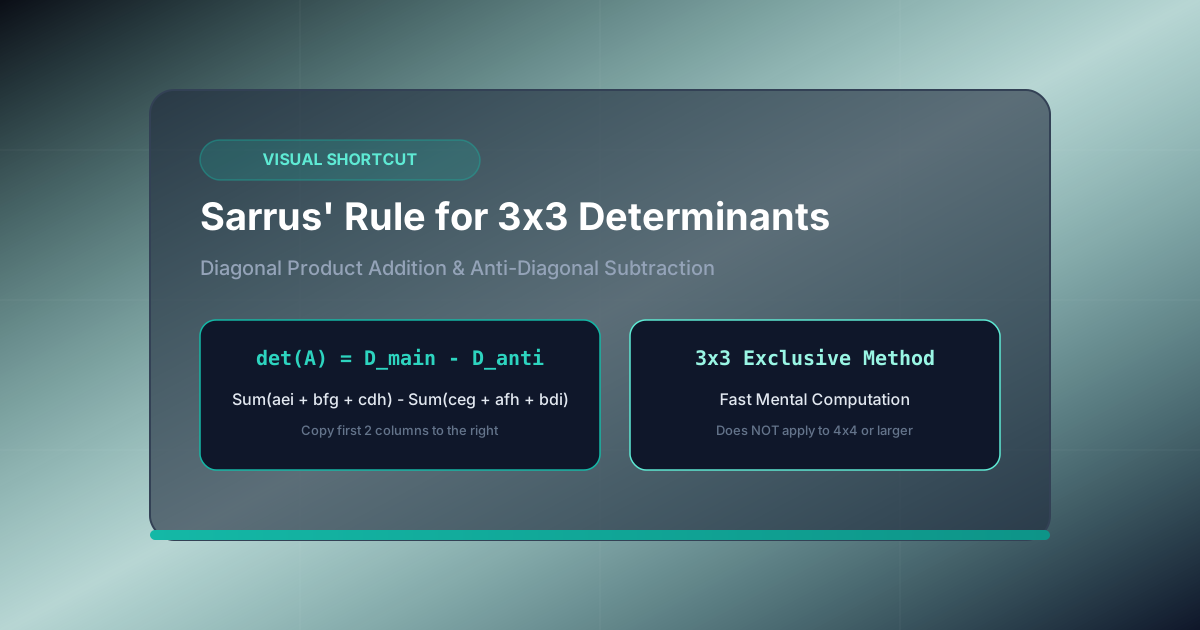
Direct Answer: Sarrus’ Rule is a diagonal multiplication shortcut exclusively for 3x3 matrix determinants: copy the first two columns to the right, sum the 3 main diagonal products $D_1 = aei + bfg + cdh$, sum the 3 anti-diagonal products $D_2 = ceg + afh + bdi$, and compute $\det(A) = D_1 - D_2$. It does NOT work on 4x4 or larger matrices.
When students first encounter 3x3 matrix determinants, calculating minors and alternating signs can feel tedious. Sarrus’ Rule (also known as the rule of diagonal multiplication) is a famous visual shortcut that speeds up manual 3x3 determinant calculations.
However, while Sarrus’ Rule is fast and reliable for 3x3 matrices, it comes with a major catch: it fails completely for 4x4 and higher-dimensional matrices.
In this article, we explain how to apply Sarrus’ Rule correctly, provide worked examples, and clarify why it cannot be generalized.
How Sarrus’ Rule Works
Consider a 3x3 matrix:
$$A = \begin{bmatrix} a & b & c \ d & e & f \ g & h & i \end{bmatrix}$$
Step 1: Augment the Matrix
Write out the matrix and append a copy of the first two columns to its right:
$$\begin{matrix} a & b & c & | & a & b \ d & e & f & | & d & e \ g & h & i & | & g & h \end{matrix}$$
Step 2: Multiply Downward Diagonals (Add)
Calculate the three top-left to bottom-right products and sum them:
$$P_{\text{down}} = (a \cdot e \cdot i) + (b \cdot f \cdot g) + (c \cdot d \cdot h)$$
Step 3: Multiply Upward Diagonals (Subtract)
Calculate the three bottom-left to top-right products and sum them:
$$P_{\text{up}} = (g \cdot e \cdot c) + (h \cdot f \cdot a) + (i \cdot d \cdot b)$$
Step 4: Subtract $P_{\text{up}}$ from $P_{\text{down}}$
$$\det(A) = P_{\text{down}} - P_{\text{up}}$$
Worked Example
Let’s evaluate the determinant of matrix $M$:
$$M = \begin{bmatrix} 1 & 2 & 3 \ 0 & 4 & 5 \ 1 & 0 & 6 \end{bmatrix}$$
-
Downward products:
- $1 \times 4 \times 6 = 24$
- $2 \times 5 \times 1 = 10$
- $3 \times 0 \times 0 = 0$
- Sum $P_{\text{down}} = 24 + 10 + 0 = 34$
-
Upward products:
- $1 \times 4 \times 3 = 12$
- $0 \times 5 \times 1 = 0$
- $6 \times 0 \times 2 = 0$
- Sum $P_{\text{up}} = 12 + 0 + 0 = 12$
-
Final Result: $$\det(M) = 34 - 12 = 22$$
Compare this result with Expansion by Minors to verify consistency.
Why Sarrus’ Rule Fails for 4x4 Matrices
A 3x3 determinant is the sum of $3! = 6$ permutations (3 positive, 3 negative). Sarrus’ Rule captures all 6 terms visually.
However, a 4x4 determinant contains $4! = 24$ permutations. If you attempt a diagonal drawing method on a 4x4 matrix, it yields only 8 terms (4 positive, 4 negative)—missing 16 critical terms! Thus, never use Sarrus’ Rule on a 4x4 matrix. For 4x4 matrices, use LU Decomposition.
Computational Determinant Algorithms vs. Manual Calculations
While Sarrus’ Rule is an intuitive method for solving $3\times 3$ matrices by hand in classrooms and examinations, software implementations utilize more scalable algorithms. As matrix dimensions expand to $4\times 4$ and beyond, algebraic complexity scales factorially ($O(n!)$).
For high-dimensional linear systems, numerical libraries rely on LU Decomposition with Partial Pivoting or Gaussian row reduction, which calculate determinants in $O(n^3)$ polynomial time. For instantaneous verification with complete precision, you can use our free interactive Determinant Solver to compute determinants up to $6\times 6$ with custom decimal accuracy.
Frequently Asked Questions (PAA)
Can Sarrus’ Rule handle negative numbers?
Yes! Be careful to track signs when multiplying negative elements along diagonals.
Who invented Sarrus’ Rule?
It was introduced by French mathematician Pierre Frédéric Sarrus in 1833 as a visual mnemonic device for students evaluating 3x3 matrices.
How does Sarrus’ Rule connect to 3D parallelepiped volume?
The 6 terms in Sarrus’ Rule expand the scalar triple product $\vec{u} \cdot (\vec{v} \times \vec{w})$. Learn more in Calculating Area and Volume Using Determinants.
Related Linear Algebra Guides
- How to Find the Determinant of a 3x3 Matrix
- LU Decomposition for Determinant Calculation
- Calculating Area and Volume Using Determinants
Need additional tools?
Explore our complete collection of SEO software, AI tools, calculators and converters.
Related Mathematical Resources
Essential matrix guides, determinant theorems, and computational tutorials
- • Reduced Row Echelon Form (RREF) – Master Gauss-Jordan row reduction, leading pivot rules, and understand why full rank RREF matrices guarantee non-zero determinants. reduced row echelon form RREF guide .
- • Matrix Multiplication & Determinants – Learn row-by-column multiplication algorithms and prove the fundamental product determinant theorem det(AB) = det(A)det(B). matrix multiplication determinant rule .
- • Solving 3 Equations 3 Unknowns – Solve 3-variable linear systems comparing matrix inversion AX=B, Cramer's rule determinant ratios, and Gaussian elimination. solving 3 equations 3 unknowns matrix method .
- • Which Matrix is Invertible? – Test if a matrix is invertible, identify singular matrices with determinant zero, and solve exam problems finding parameter k. singular matrix invertibility test .
- • LU Decomposition Method – Learn how partial pivoting and triangular factorization compute matrix determinants in O(n³) polynomial time with high numerical stability. LU decomposition determinant calculation .
- • Sarrus' Rule Shortcut – Master the visual diagonal method for rapid manual 3x3 matrix determinant evaluations without expansion errors. Sarrus rule for 3x3 determinants .
- • Cramer's Rule Guide – Step-by-step guide to solving simultaneous linear equations using coefficient matrix determinant ratios. Cramer's rule linear systems .
- • Step-by-Step Methods – Compare Laplace cofactor expansion, Gaussian row reduction, and triangular methods with complete worked proofs. determinant calculator with steps .
- • Matrix Inverses & Adjugates – Understand the relationship between non-zero determinants, invertible matrix theorems, and cofactor adjugates. matrix inverse adjugate method .