Cramersche Regel für lineare Gleichungssysteme: Anleitung & Beispiele
Lernen Sie die Cramersche Regel zur Lösung von 2x2 und 3x3 linearen Gleichungssystemen mittels Determinanten.
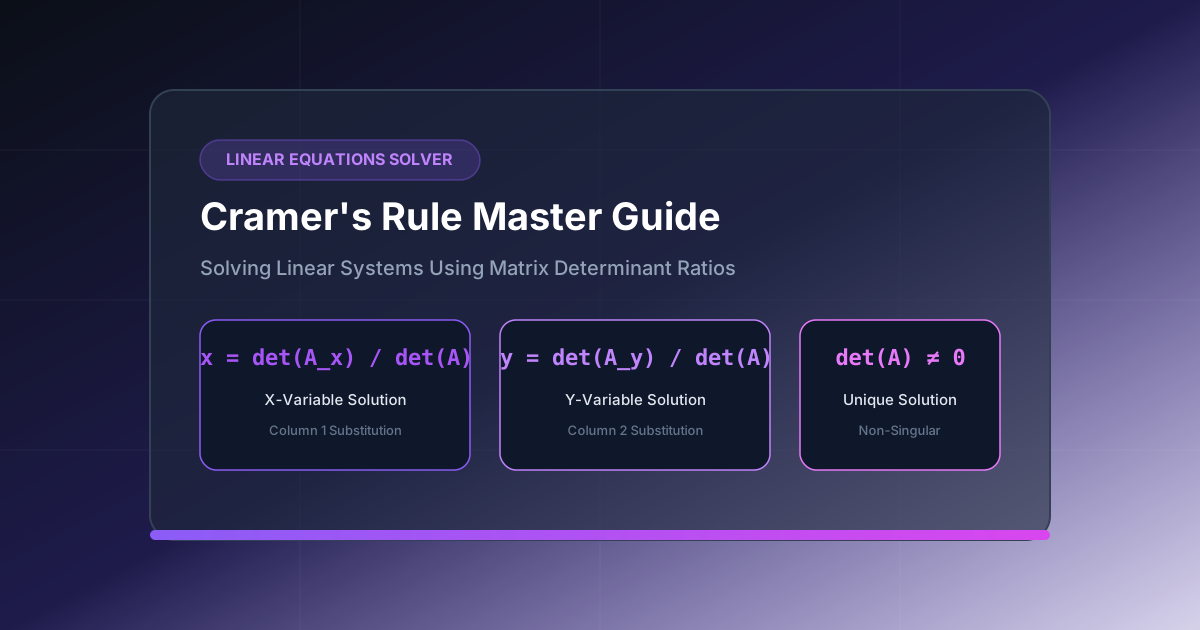
Direct Answer: Cramer’s Rule solves a system of linear equations $AX = B$ by expressing each variable as a ratio of matrix determinants: $x_i = \det(A_i) / \det(A)$, where $A_i$ is formed by replacing the $i$-th column of coefficient matrix $A$ with constant vector $B$. It applies if and only if $\det(A) \neq 0$.
Cramer’s Rule is an explicit formula for solving a system of linear equations with as many equations as unknowns, provided that the system has a unique solution. Named after Swiss mathematician Gabriel Cramer, this rule relies directly on calculating matrix determinants.
In this guide, we will break down Cramer’s Rule formula, demonstrate worked 2x2 and 3x3 examples, and analyze when to apply it in modern scientific computing.
What is Cramer’s Rule?
Consider a system of $n$ linear equations expressed in matrix form:
$$A X = B$$
Where $A$ is an $n \times n$ coefficient matrix, $X$ is the vector of variables, and $B$ is the column vector of constant terms.
If $\det(A) \neq 0$ (confirming matrix invertibility per the Invertible Matrix Theorem), Cramer’s Rule states that the value of each variable $x_i$ is given by:
$$x_i = \frac{\det(A_i)}{\det(A)}$$
Where $A_i$ is the matrix formed by replacing the $i$-th column of $A$ with the constant vector $B$.
Solving a 2x2 System of Linear Equations
Consider the system: $$2x + 3y = 8$$ $$5x - 1y = 3$$
Step 1: Form the Coefficient Matrix $A$
$$A = \begin{bmatrix} 2 & 3 \ 5 & -1 \end{bmatrix}$$
Calculate $\det(A)$: $$\det(A) = (2)(-1) - (3)(5) = -2 - 15 = -17$$
Step 2: Form $A_x$ by replacing column 1 with vector $B = \begin{bmatrix} 8 \ 3 \end{bmatrix}$
$$A_x = \begin{bmatrix} 8 & 3 \ 3 & -1 \end{bmatrix}$$
Calculate $\det(A_x)$: $$\det(A_x) = (8)(-1) - (3)(3) = -8 - 9 = -17$$
Step 3: Form $A_y$ by replacing column 2 with vector $B$
$$A_y = \begin{bmatrix} 2 & 8 \ 5 & 3 \end{bmatrix}$$
Calculate $\det(A_y)$: $$\det(A_y) = (2)(3) - (8)(5) = 6 - 40 = -34$$
Step 4: Compute Variables
$$x = \frac{\det(A_x)}{\det(A)} = \frac{-17}{-17} = 1$$ $$y = \frac{\det(A_y)}{\det(A)} = \frac{-34}{-17} = 2$$
For 3x3 linear systems, you can evaluate 3x3 determinants using Sarrus’ Rule or our step-by-step guide on How to Find the Determinant of a 3x3 Matrix.
When Should You Use Cramer’s Rule?
While Cramer’s Rule is theoretically elegant for 2x2 and 3x3 systems, its computational cost grows exponentially ($O(n!)$) if computed naively by determinants. For larger systems (4x4 and beyond), numerical methods like LU Decomposition or the Matrix Inverse Adjugate Method are far more efficient.
For small engineering problems—such as two-mesh electrical circuits or static two-bar truss balances—Cramer’s Rule offers direct, closed-form symbolic solutions for specific variables without having to solve the entire system.
To evaluate determinants for coefficient matrices and verify Cramer’s Rule intermediate values, use our interactive Determinant Solver or review our step-by-step methods in the Determinant Calculator with Steps Guide.
Frequently Asked Questions (PAA)
What happens if $\det(A) = 0$ in Cramer’s Rule?
If $\det(A) = 0$, Cramer’s Rule cannot be applied because division by zero is undefined. The system either has infinitely many solutions (dependent system) or no solution at all (inconsistent system).
Is Cramer’s Rule efficient for 10x10 matrices?
No. Computing a 10x10 determinant via naive expansion requires over 3.6 million multiplications. LU Factorization is preferred for high-dimensional systems.
Can Cramer’s Rule be used for non-square matrices?
No. Cramer’s Rule requires the coefficient matrix to be square ($n \times n$) so that determinants exist for both $A$ and modified matrices $A_i$.
Related Linear Algebra Guides
- Solving 3 Equations 3 Unknowns: Matrix Method vs Cramer’s Rule
- Reduced Row Echelon Form (RREF) Calculator & Guide
- How to Find the Determinant of a 3x3 Matrix
- LU Decomposition for Determinant Calculation
- Invertible Matrix Theorem & Determinants
Need additional tools?
Explore our complete collection of SEO software, AI tools, calculators and converters.
Related Mathematical Resources
Essential matrix guides, determinant theorems, and computational tutorials
- • Reduced Row Echelon Form (RREF) – Master Gauss-Jordan row reduction, leading pivot rules, and understand why full rank RREF matrices guarantee non-zero determinants. reduced row echelon form RREF guide .
- • Matrix Multiplication & Determinants – Learn row-by-column multiplication algorithms and prove the fundamental product determinant theorem det(AB) = det(A)det(B). matrix multiplication determinant rule .
- • Solving 3 Equations 3 Unknowns – Solve 3-variable linear systems comparing matrix inversion AX=B, Cramer's rule determinant ratios, and Gaussian elimination. solving 3 equations 3 unknowns matrix method .
- • Which Matrix is Invertible? – Test if a matrix is invertible, identify singular matrices with determinant zero, and solve exam problems finding parameter k. singular matrix invertibility test .
- • LU Decomposition Method – Learn how partial pivoting and triangular factorization compute matrix determinants in O(n³) polynomial time with high numerical stability. LU decomposition determinant calculation .
- • Sarrus' Rule Shortcut – Master the visual diagonal method for rapid manual 3x3 matrix determinant evaluations without expansion errors. Sarrus rule for 3x3 determinants .
- • Cramer's Rule Guide – Step-by-step guide to solving simultaneous linear equations using coefficient matrix determinant ratios. Cramer's rule linear systems .
- • Step-by-Step Methods – Compare Laplace cofactor expansion, Gaussian row reduction, and triangular methods with complete worked proofs. determinant calculator with steps .
- • Matrix Inverses & Adjugates – Understand the relationship between non-zero determinants, invertible matrix theorems, and cofactor adjugates. matrix inverse adjugate method .