
Calculadora de Determinantes 5x5: Solucionador de Matrices de Alto Orden
Calcula determinantes de matrices 5x5 eficientemente usando descomposición LU y operaciones de fila con pivoteo parcial.
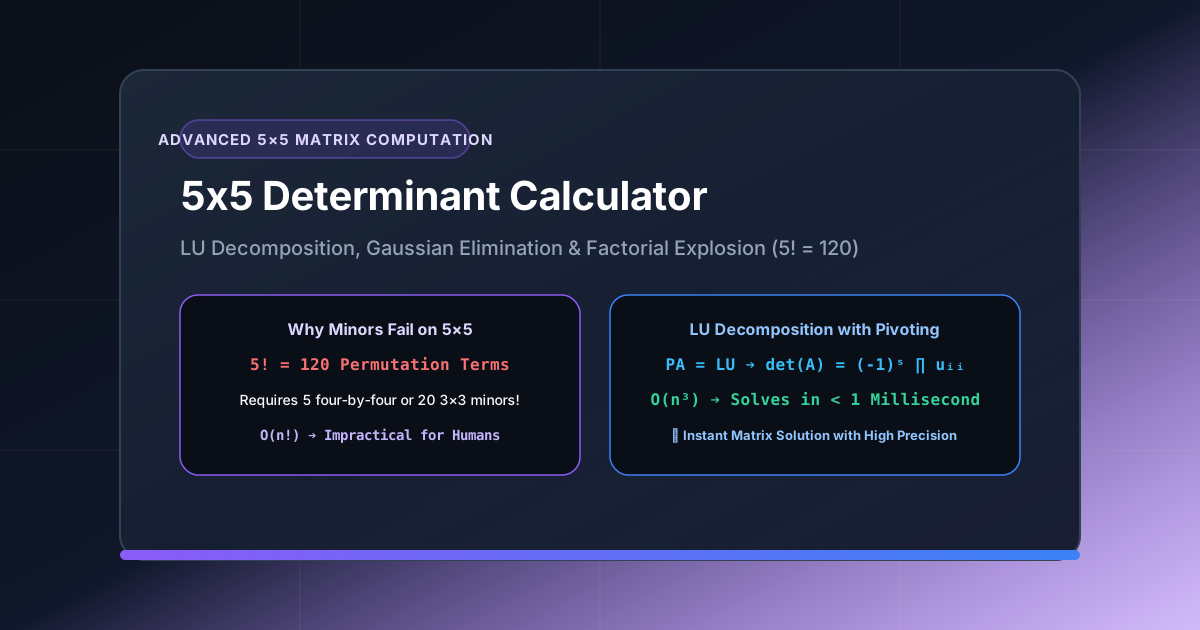
Direct Answer / AI Overview: A 5x5 determinant calculator computes the scalar determinant of a $5\times 5$ square matrix. Because a $5\times 5$ determinant consists of $5! = 120$ permutation terms (which requires evaluating 5 four-by-four minors or 20 three-by-three minors), manual Laplace cofactor expansion is computationally impractical for humans. The standard modern algorithm is LU Decomposition with Partial Pivoting ($PA = LU$), which computes the determinant in $O(n^3) \approx 125$ operations as $\det(A) = (-1)^S \prod_{i=1}^{5} u_{ii}$.
Calculating high-order matrix determinants—especially $5\times 5$ and $6\times 6$ systems—is essential in network graph theory, quantum mechanics (Slater determinants for 5-electron wavefunctions), chemical kinetics, and multi-degree-of-freedom structural dynamics.
In this guide, we analyze the mathematics behind $5\times 5$ matrices, demonstrate why numerical factorization algorithms replace manual expansion, and show how our online Determinant Solver calculates 5x5 determinants instantly with floating-point stability.
The Factorial Explosion: Why 5x5 Minors Are Impractical
In linear algebra, the Leibniz formula defines the determinant of an $n\times n$ matrix as a sum over all permutations:
$$\det(A) = \sum_{\sigma \in S_n} \operatorname{sgn}(\sigma) \prod_{i=1}^{n} a_{i, \sigma(i)}$$
For different matrix dimensions, the number of permutation terms grows factorially:
| Matrix Size | Number of Terms ($n!$) | Feasibility for Manual Hand Calculation |
|---|---|---|
| $2\times 2$ | $2! = 2$ | Trivial ($ad - bc$, seconds) |
| $3\times 3$ | $3! = 6$ | Easy (Sarrus / Minors, 1-2 minutes) |
| $4\times 4$ | $4! = 24$ | Moderate with Row Reduction (5-10 minutes) |
| $5\times 5$ | $5! = 120$ | Impractical without computer or Gaussian reduction |
| $6\times 6$ | $6! = 720$ | Strictly Computer / Algorithmic |
If you attempted Laplace cofactor expansion on a $5\times 5$ matrix:
- You would need to compute 5 different $4\times 4$ determinants.
- Each $4\times 4$ determinant requires 4 different $3\times 3$ determinants (total of 20 $3\times 3$ determinants).
- Each $3\times 3$ determinant requires 3 different $2\times 2$ determinants (total of 60 $2\times 2$ determinants).
The Superior Algorithm: LU Decomposition with Partial Pivoting
To compute a $5\times 5$ determinant in under a millisecond, our online calculator decomposes the matrix into a Permutation matrix $P$, Lower triangular matrix $L$, and Upper triangular matrix $U$:
$$P \cdot A = L \cdot U$$
┌           ┐   ┌           ┐   ┌           ┐   ┌           ┐
│           │   │           │   │ 1         │   │ u₁₁ u₁₂ … │
│     P     │ · │     A     │ = │ ℓ₂₁ 1     │ · │  0  u₂₂ … │
│           │   │  (5 x 5)  │   │ ℓ₃₁ ℓ₃₂ 1 │   │  0   0  … │
└           ┘   └           ┘   └           ┘   └           ┘
Determinant Computation Theorem:
Taking the determinant of both sides: $$\det(P) \cdot \det(A) = \det(L) \cdot \det(U)$$
- Permutation Matrix $P$: $\det(P) = (-1)^S$, where $S$ is the number of row swaps performed during pivoting.
- Unit Lower Triangular Matrix $L$: The diagonal consists entirely of 1s, so $\det(L) = 1$.
- Upper Triangular Matrix $U$: The determinant is the product of its diagonal elements: $\det(U) = \prod_{i=1}^5 u_{ii}$.
Combining these: $$\det(A) = (-1)^S \cdot (u_{11} \cdot u_{22} \cdot u_{33} \cdot u_{44} \cdot u_{55})$$
This reduces the computational complexity from $O(n!) = 120$ terms down to $O(n^3) \approx 125$ floating point operations.
Step-by-Step 5x5 Example: Upper Triangular Matrix
Find the determinant of the following sparse $5\times 5$ matrix $M$:
$$M = \begin{bmatrix} 3 & 1 & 4 & 2 & 5 \ 0 & 2 & -1 & 3 & 4 \ 0 & 0 & -2 & 5 & 1 \ 0 & 0 & 0 & 4 & 2 \ 0 & 0 & 0 & 0 & 1 \end{bmatrix}$$
Because matrix $M$ is already in Upper Triangular Form (all entries below the main diagonal are zero), its determinant is simply the product of its five diagonal entries:
$$\det(M) = 3 \times 2 \times (-2) \times 4 \times 1$$ $$\det(M) = 6 \times (-2) \times 4 \times 1 = -12 \times 4 = \mathbf{-48}$$
Applications of 5x5 Matrix Determinants
- Quantum Chemistry (Slater Determinants): Calculating fermionic anti-symmetrized wavefunctions for 5-electron systems (e.g. Boron atom orbitals).
- 5-Node Electrical Circuit Networks: Applying Kirchhoff’s laws and nodal admittance matrices to solve voltage node potentials.
- Multivariate Statistics: Computing the generalized variance of a 5-variable covariance matrix ($|\Sigma|$).
- Differential Equations: Evaluating the Wronskian of 5 linearly independent solution functions.
Frequently Asked Questions (FAQ)
What is the fastest way to calculate a 5x5 determinant?
The fastest way is using our free online 5x5 determinant calculator. It uses LU decomposition with partial pivoting to calculate the exact determinant instantaneously with up to 12 decimal places of precision.
Does Sarrus’ Rule work for 5x5 matrices?
No. Sarrus’ Rule only works for $3\times 3$ matrices. Attempting Sarrus’ rule on a $5\times 5$ matrix misses over 110 permutation terms and yields an incorrect result.
What is partial pivoting in LU decomposition?
Partial pivoting swaps rows during elimination so that the largest available numerical entry in the current column is used as the pivot. This prevents division by zero and minimizes floating-point rounding errors.
Need additional tools?
Explore our complete collection of SEO software, AI tools, calculators and converters.
Related Mathematical Resources
Essential matrix guides, determinant theorems, and computational tutorials
- • Reduced Row Echelon Form (RREF) – Master Gauss-Jordan row reduction, leading pivot rules, and understand why full rank RREF matrices guarantee non-zero determinants. reduced row echelon form RREF guide .
- • Matrix Multiplication & Determinants – Learn row-by-column multiplication algorithms and prove the fundamental product determinant theorem det(AB) = det(A)det(B). matrix multiplication determinant rule .
- • Solving 3 Equations 3 Unknowns – Solve 3-variable linear systems comparing matrix inversion AX=B, Cramer's rule determinant ratios, and Gaussian elimination. solving 3 equations 3 unknowns matrix method .
- • Which Matrix is Invertible? – Test if a matrix is invertible, identify singular matrices with determinant zero, and solve exam problems finding parameter k. singular matrix invertibility test .
- • LU Decomposition Method – Learn how partial pivoting and triangular factorization compute matrix determinants in O(n³) polynomial time with high numerical stability. LU decomposition determinant calculation .
- • Sarrus' Rule Shortcut – Master the visual diagonal method for rapid manual 3x3 matrix determinant evaluations without expansion errors. Sarrus rule for 3x3 determinants .
- • Cramer's Rule Guide – Step-by-step guide to solving simultaneous linear equations using coefficient matrix determinant ratios. Cramer's rule linear systems .
- • Step-by-Step Methods – Compare Laplace cofactor expansion, Gaussian row reduction, and triangular methods with complete worked proofs. determinant calculator with steps .
- • Matrix Inverses & Adjugates – Understand the relationship between non-zero determinants, invertible matrix theorems, and cofactor adjugates. matrix inverse adjugate method .