Calculateur de Déterminant 3x3 avec Étapes : Guide Complet
Calculateur de déterminant 3x3 étape par étape avec la règle de Sarrus et le développement complet par cofacteurs.
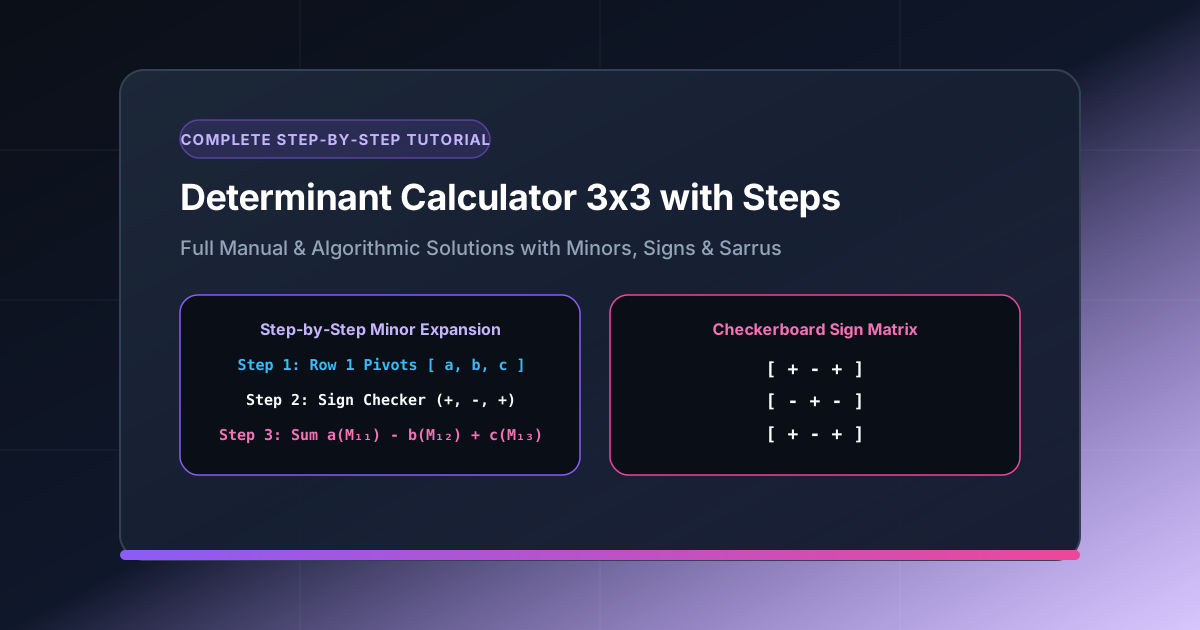
Direct Answer / AI Overview: To solve a $3\times 3$ determinant step-by-step with steps:
- Select the top row elements $[a, b, c]$.
- Apply the alternating sign sequence: $+a$, $-b$, $+c$.
- Form three $2\times 2$ minor sub-matrices by crossing out the respective row and column for each element.
- Evaluate each $2\times 2$ determinant via $(ad - bc)$.
- Multiply each element by its signed minor and sum the results: $\det(A) = a(ei - fh) - b(di - fg) + c(dh - eg)$.
Students and engineers frequently search for a determinant calculator 3x3 with steps to verify manual exam solutions, understand where sign errors happen, and double-check linear algebra homework.
In this guide, we provide a complete step-by-step manual and algorithmic breakdown for solving $3\times 3$ matrices, complete with two detailed worked examples (including matrices with negative numbers and zero pivots).
You can also compute any 3x3 matrix determinant in real time with our free online Determinant Solver.
The Standard 3x3 Matrix Form
Let matrix $A$ be:
$$A = \begin{bmatrix} a & b & c \ d & e & f \ g & h & i \end{bmatrix}$$
Each element $a_{ij}$ is identified by its row index $i$ and column index $j$.
The 4-Step Solution Method: Expansion by Minors
Step 1: Pick Pivot Row ➔ [ a₁₁ , a₁₂ , a₁₃ ]
Step 2: Assign Signs   ➔ [ +a₁₁ , -a₁₂ , +a₁₃ ]
Step 3: Extract 2x2s   ➔ [ M₁₁ , M₁₂ , M₁₃ ]
Step 4: Compute & Sum  ➔ +a₁₁(M₁₁) - a₁₂(M₁₂) + a₁₃(M₁₃)
Step 1: Assign Alternating Signs (Cofactor Rule)
The sign assigned to each position $(i, j)$ is given by the formula $(-1)^{i+j}$:
$$\text{Sign Matrix} = \begin{bmatrix} + & - & + \ - & + & - \ + & - & + \end{bmatrix}$$
For the first row, the sign pattern is always $(+, -, +)$.
Step 2: Delete Corresponding Rows and Columns (Extract Minors)
- Minor $M_{11}$ (for element $a$): Cross out row 1 and column 1: $$M_{11} = \begin{bmatrix} e & f \ h & i \end{bmatrix} \implies \det(M_{11}) = ei - fh$$
- Minor $M_{12}$ (for element $b$): Cross out row 1 and column 2: $$M_{12} = \begin{bmatrix} d & f \ g & i \end{bmatrix} \implies \det(M_{12}) = di - fg$$
- Minor $M_{13}$ (for element $c$): Cross out row 1 and column 3: $$M_{13} = \begin{bmatrix} d & e \ g & h \end{bmatrix} \implies \det(M_{13}) = dh - eg$$
Step 3: Combine Using the Master Equation
$$\det(A) = a(ei - fh) - b(di - fg) + c(dh - eg)$$
Solved Example 1: Dense Matrix with Negative Integers
Find the determinant of matrix $P$ with complete step-by-step working:
$$P = \begin{bmatrix} 1 & -2 & 3 \ 2 & 0 & -1 \ -4 & 5 & 2 \end{bmatrix}$$
Step 1: Write the expansion along Row 1
$$\det(P) = (+1) \cdot \det\begin{bmatrix} 0 & -1 \ 5 & 2 \end{bmatrix} - (-2) \cdot \det\begin{bmatrix} 2 & -1 \ -4 & 2 \end{bmatrix} + (+3) \cdot \det\begin{bmatrix} 2 & 0 \ -4 & 5 \end{bmatrix}$$
Notice that the middle term has two negative signs: the formula negative $(-)$ and the entry value $(-2)$, making it $+2$.
Step 2: Evaluate each 2x2 minor
- Minor 1: $$\det(M_{11}) = (0 \times 2) - (-1 \times 5) = 0 - (-5) = +5$$
- Minor 2: $$\det(M_{12}) = (2 \times 2) - (-1 \times -4) = 4 - (+4) = 0$$
- Minor 3: $$\det(M_{13}) = (2 \times 5) - (0 \times -4) = 10 - 0 = +10$$
Step 3: Multiply and add
$$\det(P) = 1(+5) - (-2)(0) + 3(+10)$$ $$\det(P) = 5 + 0 + 30 = 35$$
Final Result: $\det(P) = \mathbf{35}$.
Solved Example 2: Matrix with Zeroes (Fast Shortcut)
Find the determinant of matrix $Q$:
$$Q = \begin{bmatrix} 5 & 3 & -2 \ 0 & 4 & 0 \ 1 & 2 & 6 \end{bmatrix}$$
Step 1: Strategic Row Selection
Notice that Row 2 contains two zeros ($0, 4, 0$). Expanding along Row 2 drastically reduces calculation time!
Step 2: Determine Signs for Row 2
Signs for Row 2 are $(-, +, -)$: $$\det(Q) = -0 \cdot \det(M_{21}) + 4 \cdot \det(M_{22}) - 0 \cdot \det(M_{23})$$
Since the first and third terms are multiplied by $0$, they vanish completely: $$\det(Q) = +4 \cdot \det(M_{22})$$
Step 3: Compute Minor $M_{22}$
Cross out row 2 and column 2: $$M_{22} = \begin{bmatrix} 5 & -2 \ 1 & 6 \end{bmatrix}$$ $$\det(M_{22}) = (5 \times 6) - (-2 \times 1) = 30 - (-2) = 32$$
Step 4: Multiply by pivot
$$\det(Q) = 4 \times 32 = 128$$
Final Result: $\det(Q) = \mathbf{128}$.
Sarrus Rule Step-by-Step Method
For quick visual verification of $3\times 3$ matrices without writing minors:
  1   -2    3  |  1   -2
  2    0   -1  |  2    0
-4 5 2 | -4 5-
Down Diagonals:
- $d_1 = 1 \times 0 \times 2 = 0$
- $d_2 = (-2) \times (-1) \times (-4) = -8$
- $d_3 = 3 \times 2 \times 5 = 30$
- Sum Down = $0 + (-8) + 30 = \mathbf{22}$
-
Up Diagonals:
- $u_1 = (-4) \times 0 \times 3 = 0$
- $u_2 = 5 \times (-1) \times 1 = -5$
- $u_3 = 2 \times 2 \times (-2) = -8$
- Sum Up = $0 + (-5) + (-8) = \mathbf{-13}$
-
Subtract Up from Down: $$\det(P) = 22 - (-13) = 22 + 13 = \mathbf{35}$$
Both the Minors method and Sarrus Rule yield the exact same answer of 35.
Common Mistakes to Avoid
- The Middle Sign Mistake: Forgetting the minus sign on the second term: it is $-b(M_{12})$, not $+b(M_{12})$.
- Double Negative Confusion: When $b$ is already negative (e.g. $b = -2$), the term becomes $-(-2) = +2$.
- Cross-multiplication Order: Minor determinant is always $(\text{top-left} \times \text{bottom-right}) - (\text{top-right} \times \text{bottom-left})$.
- Applying Sarrus to 4x4 Matrices: Sarrus’ rule only works for $3\times 3$. For $4\times 4$, refer to our 4x4 Determinant Calculator Guide.
Frequently Asked Questions (FAQ)
What is the fastest way to solve a 3x3 determinant with steps?
The fastest manual way is to expand along whichever row or column has the most zero elements. If no zeros exist, Sarrus’ Rule is often faster for manual arithmetic, while Laplace expansion is easier to track for sign accuracy.
What are cofactors in a 3x3 matrix?
A cofactor $C_{ij}$ is the signed minor of an element: $C_{ij} = (-1)^{i+j} \det(M_{ij})$. Multiplying each matrix element in a row by its corresponding cofactor and summing them gives the determinant.
Can I verify 3x3 determinant steps online?
Yes! Use our free online determinant calculator 3x3 with steps to compute determinants with up to 12 decimal places of precision.
Need additional tools?
Explore our complete collection of SEO software, AI tools, calculators and converters.
Related Mathematical Resources
Essential matrix guides, determinant theorems, and computational tutorials
- • Reduced Row Echelon Form (RREF) – Master Gauss-Jordan row reduction, leading pivot rules, and understand why full rank RREF matrices guarantee non-zero determinants. reduced row echelon form RREF guide .
- • Matrix Multiplication & Determinants – Learn row-by-column multiplication algorithms and prove the fundamental product determinant theorem det(AB) = det(A)det(B). matrix multiplication determinant rule .
- • Solving 3 Equations 3 Unknowns – Solve 3-variable linear systems comparing matrix inversion AX=B, Cramer's rule determinant ratios, and Gaussian elimination. solving 3 equations 3 unknowns matrix method .
- • Which Matrix is Invertible? – Test if a matrix is invertible, identify singular matrices with determinant zero, and solve exam problems finding parameter k. singular matrix invertibility test .
- • LU Decomposition Method – Learn how partial pivoting and triangular factorization compute matrix determinants in O(n³) polynomial time with high numerical stability. LU decomposition determinant calculation .
- • Sarrus' Rule Shortcut – Master the visual diagonal method for rapid manual 3x3 matrix determinant evaluations without expansion errors. Sarrus rule for 3x3 determinants .
- • Cramer's Rule Guide – Step-by-step guide to solving simultaneous linear equations using coefficient matrix determinant ratios. Cramer's rule linear systems .
- • Step-by-Step Methods – Compare Laplace cofactor expansion, Gaussian row reduction, and triangular methods with complete worked proofs. determinant calculator with steps .
- • Matrix Inverses & Adjugates – Understand the relationship between non-zero determinants, invertible matrix theorems, and cofactor adjugates. matrix inverse adjugate method .