
फास्ट मैट्रिक्स निर्धारक के लिए एलयू अपघटन: O(n³) एल्गोरिदम
समझें कि एलयू अपघटन आंशिक पिवोटिंग का उपयोग करके O(n³) समय में बड़े मैट्रिक्स निर्धारकों की गणना कैसे करता है।
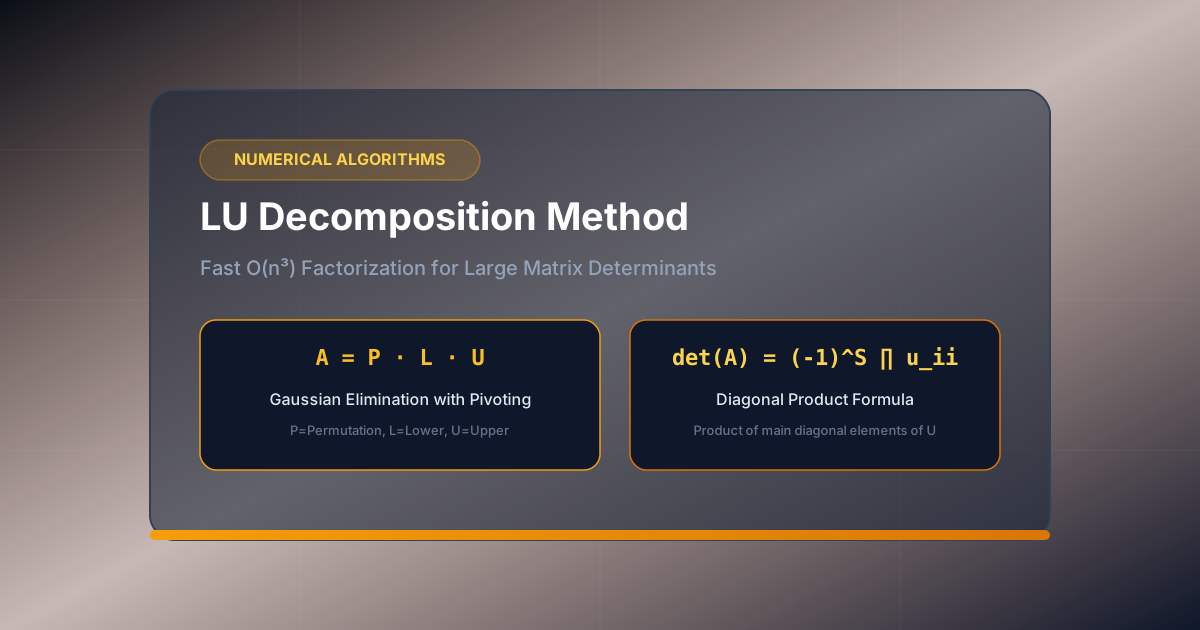
Direct Answer: LU Decomposition calculates matrix determinants by factoring coefficient matrix $A$ into lower ($L$) and upper ($U$) triangular matrices with row permutation matrix $P$: $PA = LU$. Because the determinant of a triangular matrix equals the product of its diagonal entries, $\det(A) = (-1)^s \prod u_{ii}$, where $s$ is the number of row swaps.
When calculating determinants for small matrices like 2x2 or 3x3, cofactor expansion or Sarrus’ Rule is straightforward. However, for 4x4, 5x5, 6x6, or larger matrices, naive expansion by minors requires $O(n!)$ operations—making it computationally impossible even on supercomputers.
To solve large matrices in milliseconds, numerical algorithms rely on LU Decomposition with Partial Pivoting ($P A = L U$). In this guide, we explore how LU factorization works and why computers use it.
The Computational Bottleneck of Minor Expansion
Comparing time complexity between algorithms highlights why LU decomposition is essential:
- Laplace Expansion (Minors): $O(n!)$ time complexity. A 10x10 matrix requires over 3.6 million operations! See How to Find 3x3 Determinant Step by Step for minor expansion details.
- LU Factorization: $O(n^3)$ time complexity. A 10x10 matrix requires only ~1,000 operations!
What is LU Decomposition?
LU decomposition factors a square matrix $A$ into the product of a lower triangular matrix $L$ and an upper triangular matrix $U$, controlled by a permutation matrix $P$ for row swaps:
$$P A = L U$$
- Matrix $P$ (Permutation): Tracks row interchanges performed to maintain numerical stability during partial pivoting. $\det(P) = (-1)^s$, where $s$ is the number of row swaps.
- Matrix $L$ (Lower Triangular): Has 1s on the main diagonal. Therefore, $\det(L) = 1$.
- Matrix $U$ (Upper Triangular): Has entries $u_{ii}$ on the main diagonal. Its determinant is the product of its diagonal elements: $$\det(U) = \prod_{i=1}^n u_{ii}$$
Formula for Determinant via LU
Using the multiplicative property of determinants ($\det(AB) = \det(A)\det(B)$ as explained in Matrix Determinant Properties):
$$\det(P) \cdot \det(A) = \det(L) \cdot \det(U)$$
Since $\det(P) = (-1)^s$ and $\det(L) = 1$:
$$\det(A) = (-1)^s \cdot \prod_{i=1}^n u_{ii}$$
The determinant of $A$ equals the product of the diagonal elements of $U$, multiplied by $-1$ for every row swap performed!
Worked Example: LU Decomposition of a 3x3 Matrix
Find $\det(A)$ using LU decomposition (Doolittle, no row swaps so $s = 0$):
$$A = \begin{bmatrix} 2 & 1 & 1 \ 4 & 3 & 3 \ 8 & 7 & 9 \end{bmatrix}$$
Step 1 – Eliminate column 1. Multipliers $l_{21} = 4/2 = 2$ and $l_{31} = 8/2 = 4$:
- $R_2 \leftarrow R_2 - 2R_1 = [0,\ 1,\ 1]$
- $R_3 \leftarrow R_3 - 4R_1 = [0,\ 3,\ 5]$
Step 2 – Eliminate column 2. Multiplier $l_{32} = 3/1 = 3$:
- $R_3 \leftarrow R_3 - 3R_2 = [0,\ 0,\ 2]$
Step 3 – Read off L and U. The multipliers fill $L$; the reduced rows form $U$:
$$L = \begin{bmatrix} 1 & 0 & 0 \ 2 & 1 & 0 \ 4 & 3 & 1 \end{bmatrix}, \quad U = \begin{bmatrix} 2 & 1 & 1 \ 0 & 1 & 1 \ 0 & 0 & 2 \end{bmatrix}$$
Step 4 – Multiply the diagonal of U.
$$\det(A) = (-1)^0 \cdot (2 \cdot 1 \cdot 2) = \mathbf{4}$$
Check with cofactor expansion: $2(27-21) - 1(36-24) + 1(28-24) = 12 - 12 + 4 = 4$ ✓
With partial pivoting, the algorithm would first swap the row starting with $8$ to the top. The factors $L$ and $U$ change, but after applying the $(-1)^s$ sign for the swaps the determinant is still $4$. You can verify any matrix up to 6x6 with our determinant calculator.
Numerical Stability: Why Partial Pivoting Matters
When computers perform division by near-zero values during Gaussian elimination, rounding errors can accumulate exponentially. Partial pivoting selects the row with the largest absolute value in the pivot column before eliminating sub-diagonal elements, preserving precision and verifying conditions in the Invertible Matrix Theorem.
Our online determinant solver implements LU decomposition with partial pivoting in pure JavaScript, allowing instantaneous, robust calculations up to 6x6.
Algorithmic Complexity & Practical Implementation
Algorithmic efficiency is the cornerstone of scientific computing. While naive cofactor expansion requires $O(n!)$ multiplications, Doolittle’s and Crout’s LU factorizations compute determinants in $O(n^3)$ operations.
For practical software implementation, combining forward and back substitution with LU factorization enables solving linear systems $Ax = b$ in $O(n^2)$ time once the matrix is factored. To compare computational methods in detail, explore our guide on Determinant Calculator with Steps: Complete Guide to Step-by-Step Matrix Methods or test your own matrices on our interactive Determinant Solver.
Frequently Asked Questions (PAA)
Can LU decomposition fail?
LU decomposition without pivoting fails if a zero pivot is encountered. However, LU decomposition with partial pivoting ($PA=LU$) is guaranteed to succeed for any non-singular square matrix where $\det(A) \neq 0$.
Why is $\det(L) = 1$?
By convention in Doolittle algorithm LU factorization, $L$ is a unit lower triangular matrix with 1s along the main diagonal. Since it is triangular, its determinant is the product of diagonal 1s, which equals 1.
How fast is LU decomposition for high-order matrices?
LU decomposition operates in $O(n^3)$ polynomial time. This enables calculating determinants for 100x100 matrices in less than a second on modern computer processors.
What is the determinant of a triangular matrix?
The determinant of a triangular matrix is the product of its diagonal entries. That is exactly why LU decomposition works: once $A$ is factored into $L$ and $U$, the determinant comes straight from the diagonal of $U$. Our determinant of a triangular matrix guide proves this with worked examples for upper, lower and diagonal matrices.
How does LU decomposition relate to RREF?
Both use row operations, but they stop at different places. LU decomposition stops at an upper triangular $U$ and reads the determinant off its diagonal, while Gauss-Jordan elimination continues to full RREF to solve the system. For a determinant alone, LU is the shorter route.
Related Linear Algebra Guides
- Reduced Row Echelon Form (RREF) Calculator & Guide
- Determinant of a Triangular Matrix
- How to Find the Determinant of a 3x3 Matrix
- Matrix Determinant Properties Explained
- Invertible Matrix Theorem & Determinants
Related Mathematical Resources
Essential matrix guides, determinant theorems, and computational tutorials
- • Sarrus' Rule Shortcut – Master the visual diagonal method for rapid manual 3x3 matrix determinant evaluations without expansion errors. Sarrus rule for 3x3 determinants .
- • LU Decomposition Method – Learn how partial pivoting and triangular factorization compute matrix determinants with high numerical stability. LU decomposition determinant calculation .
- • Cramer's Rule Guide – Step-by-step guide to solving simultaneous linear equations using coefficient matrix determinant ratios. Cramer's rule linear systems .