Come Trovare il Determinante di una Matrice 3x3 Passo dopo Passo
Tutorial completo passo dopo passo per calcolare il determinante di una matrice 3x3 con lo sviluppo di Laplace.
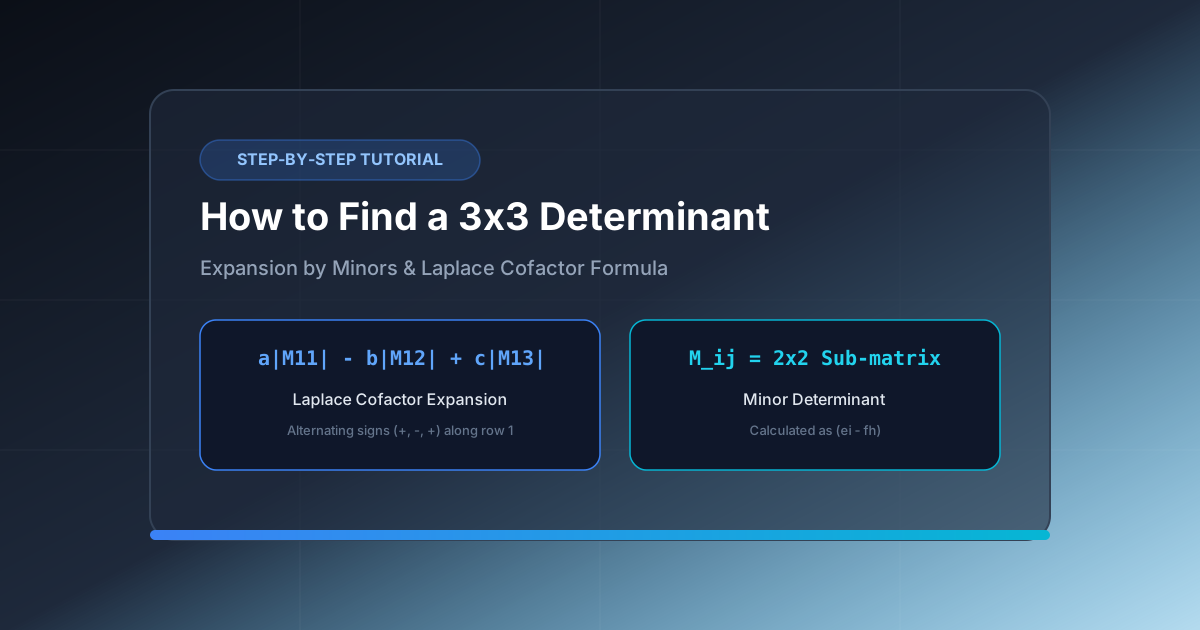
Direct Answer: To find the determinant of a 3x3 matrix using Expansion by Minors along the top row, multiply each first-row element by its corresponding 2x2 sub-matrix minor determinant, applying alternating signs (+, -, +): $\det(A) = a(ei - fh) - b(di - fg) + c(dh - eg)$.
Calculating the determinant of a 3x3 matrix is a fundamental skill in linear algebra, physics, and computer science. Whether you are solving systems of linear equations via Cramer’s Rule, calculating 3D volumes in Geometric Area and Volume Analysis, or analyzing structural dynamics in engineering, understanding how to compute a 3x3 determinant is essential.
In this guide, we will walk step-by-step through both standard methods: Expansion by Minors (Laplace Expansion) and Sarrus’ Rule, complete with worked examples and numerical insights.
What is a 3x3 Determinant?
A 3x3 matrix consists of 3 rows and 3 columns of real or complex numbers arranged as follows:
$$A = \begin{bmatrix} a & b & c \ d & e & f \ g & h & i \end{bmatrix}$$
The determinant of matrix $A$, denoted as $\det(A)$ or $|A|$, is a scalar value that describes the scaling factor of the transformation mapped by the matrix. If $\det(A) = 0$, the matrix is singular and cannot be inverted according to the Invertible Matrix Theorem.
In linear algebra, computing determinants accurately is fundamental for solving simultaneous equations, computing eigenvalues, and performing geometric coordinate transformations.
Method 1: Expansion by Minors (Laplace Expansion)
The general formula to calculate the determinant along the top row is:
$$\det(A) = a \cdot \det\begin{bmatrix} e & f \ h & i \end{bmatrix} - b \cdot \det\begin{bmatrix} d & f \ g & i \end{bmatrix} + c \cdot \det\begin{bmatrix} d & e \ g & h \end{bmatrix}$$
Expanding each 2x2 sub-determinant ($\det = ad - bc$):
$$\det(A) = a(ei - fh) - b(di - fg) + c(dh - eg)$$
Step-by-Step Example
Let’s find the determinant of matrix $B$:
$$B = \begin{bmatrix} 3 & 1 & 2 \ 2 & 4 & 5 \ 6 & 7 & 8 \end{bmatrix}$$
- Calculate the first 2x2 minor: $$\det\begin{bmatrix} 4 & 5 \ 7 & 8 \end{bmatrix} = (4 \times 8) - (5 \times 7) = 32 - 35 = -3$$
- Calculate the second 2x2 minor: $$\det\begin{bmatrix} 2 & 5 \ 6 & 8 \end{bmatrix} = (2 \times 8) - (5 \times 6) = 16 - 30 = -14$$
- Calculate the third 2x2 minor: $$\det\begin{bmatrix} 2 & 4 \ 6 & 7 \end{bmatrix} = (2 \times 7) - (4 \times 6) = 14 - 24 = -10$$
- Combine using the alternating signs (+, -, +): $$\det(B) = 3(-3) - 1(-14) + 2(-10) = -9 + 14 - 20 = -15$$
Method 2: Sarrus’ Rule (Diagonal Shortcut)
Sarrus’ Rule is a popular visual shortcut used exclusively for 3x3 matrices:
- Copy the first two columns to the right of the matrix.
- Sum the products of the three main diagonals going top-left to bottom-right: $$D_1 = (a \cdot e \cdot i) + (b \cdot f \cdot g) + (c \cdot d \cdot h)$$
- Sum the products of the three anti-diagonals going bottom-left to top-right: $$D_2 = (c \cdot e \cdot g) + (a \cdot f \cdot h) + (b \cdot d \cdot i)$$
- Subtract $D_2$ from $D_1$: $$\det(A) = D_1 - D_2$$
For a dedicated deep-dive into this diagonal method, explore our guide on Sarrus’ Rule for 3x3 Determinants.
To quickly verify your manual answers and check step-by-step solutions, use our free online Determinant Solver to compute $2\times 2$ up to $6\times 6$ determinants with customizable decimal precision.
Frequently Asked Questions (PAA)
What does it mean if a 3x3 determinant is zero?
If the determinant is zero ($\det(A) = 0$), the matrix is singular, meaning its rows or columns are linearly dependent and it does not possess an inverse.
Can Sarrus’ Rule be used for 4x4 matrices?
No! Sarrus’ Rule only works for 3x3 matrices. For 4x4 or larger matrices, you must use cofactor expansion or LU Decomposition.
Does it matter which row or column you expand along?
No. Thanks to Laplace Expansion properties, expanding along any row or column yields the exact same determinant value. Expanding along rows or columns with zeros reduces calculation steps.
Related Linear Algebra Guides
- Sarrus’ Rule for 3x3 Determinants
- Cramer’s Rule: Solving Linear Systems
- LU Decomposition for Determinant Calculation
Need additional tools?
Explore our complete collection of SEO software, AI tools, calculators and converters.
Related Mathematical Resources
Essential matrix guides, determinant theorems, and computational tutorials
- • Reduced Row Echelon Form (RREF) – Master Gauss-Jordan row reduction, leading pivot rules, and understand why full rank RREF matrices guarantee non-zero determinants. reduced row echelon form RREF guide .
- • Matrix Multiplication & Determinants – Learn row-by-column multiplication algorithms and prove the fundamental product determinant theorem det(AB) = det(A)det(B). matrix multiplication determinant rule .
- • Solving 3 Equations 3 Unknowns – Solve 3-variable linear systems comparing matrix inversion AX=B, Cramer's rule determinant ratios, and Gaussian elimination. solving 3 equations 3 unknowns matrix method .
- • Which Matrix is Invertible? – Test if a matrix is invertible, identify singular matrices with determinant zero, and solve exam problems finding parameter k. singular matrix invertibility test .
- • LU Decomposition Method – Learn how partial pivoting and triangular factorization compute matrix determinants in O(n³) polynomial time with high numerical stability. LU decomposition determinant calculation .
- • Sarrus' Rule Shortcut – Master the visual diagonal method for rapid manual 3x3 matrix determinant evaluations without expansion errors. Sarrus rule for 3x3 determinants .
- • Cramer's Rule Guide – Step-by-step guide to solving simultaneous linear equations using coefficient matrix determinant ratios. Cramer's rule linear systems .
- • Step-by-Step Methods – Compare Laplace cofactor expansion, Gaussian row reduction, and triangular methods with complete worked proofs. determinant calculator with steps .
- • Matrix Inverses & Adjugates – Understand the relationship between non-zero determinants, invertible matrix theorems, and cofactor adjugates. matrix inverse adjugate method .