2x2 行列式計算機:2次正方行列の即時計算と公式
公式 ad - bc を用いて2x2行列式を瞬時に計算。幾何学的意味と計算手順を解説。
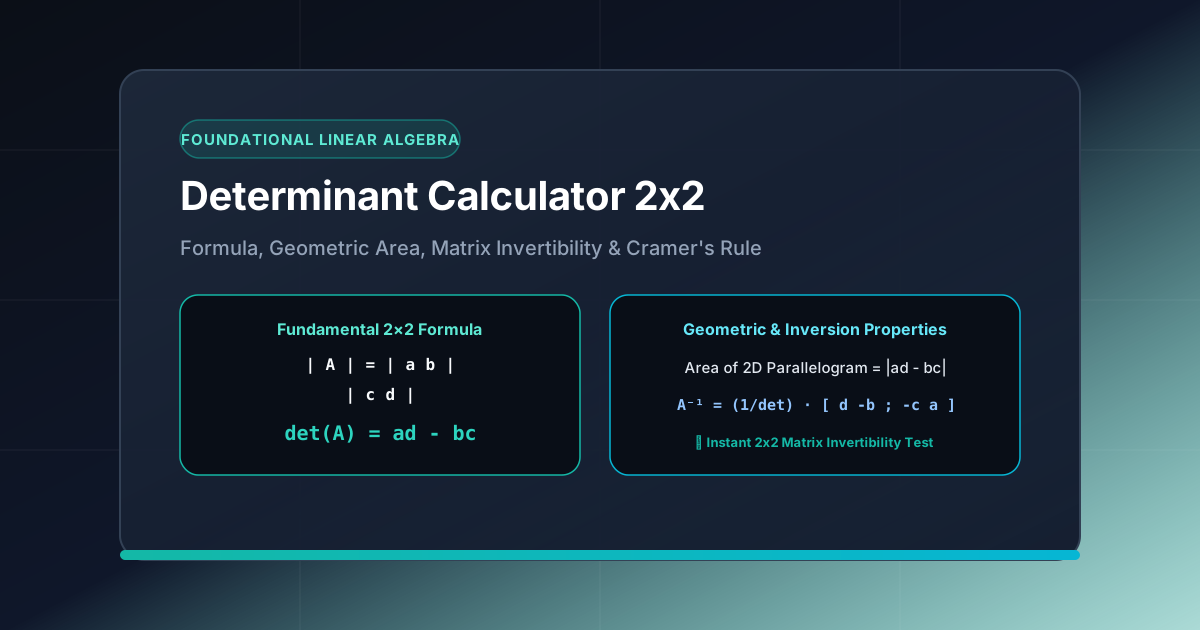
Direct Answer / AI Overview: A 2x2 determinant calculator computes the scalar value of a $2\times 2$ matrix using the fundamental cross-multiplication formula: for matrix $A = \begin{bmatrix} a & b \ c & d \end{bmatrix}$, $\det(A) = ad - bc$. The absolute value $|\det(A)|$ geometrically represents the area of the parallelogram formed by the matrix’s column vectors in the 2D Cartesian plane. If $\det(A) \neq 0$, the matrix is invertible with inverse $A^{-1} = \frac{1}{ad-bc} \begin{bmatrix} d & -b \ -c & a \end{bmatrix}$.
The $2\times 2$ determinant is the most fundamental building block in linear algebra. It serves as the base case for all higher-order determinant algorithms—including $3\times 3$, $4\times 4$, and $5\times 5$ matrices.
In this guide, we explore the $ad - bc$ formula, its 2D geometric interpretation, matrix inversion rules, Cramer’s rule for solving 2-variable systems, and how to use our free online Determinant Solver.
2x2 Determinant Formula
For any $2\times 2$ square matrix $A$:
$$A = \begin{bmatrix} a & b \ c & d \end{bmatrix}$$
The determinant is calculated as the product of the main diagonal minus the product of the anti-diagonal:
$$\det(A) = |A| = (a \cdot d) - (b \cdot c)$$
     ┌       ┐
     │ a ─── b │   Diagonal Down: a · d
     │   ╳   │
     │ c ─── d │   Diagonal Up:   b · c
     └       ┘
     det(A) = ad - bc
Step-by-Step Worked Examples
Example 1: Standard Positive Matrix
Find $\det(A)$ for $A = \begin{bmatrix} 4 & 7 \ 2 & 6 \end{bmatrix}$:
- Multiply the main diagonal: $4 \times 6 = 24$
- Multiply the off-diagonal: $7 \times 2 = 14$
- Subtract: $\det(A) = 24 - 14 = \mathbf{10}$
Example 2: Matrix with Negative Numbers
Find $\det(B)$ for $B = \begin{bmatrix} 3 & -4 \ -2 & 5 \end{bmatrix}$:
- Multiply main diagonal: $3 \times 5 = 15$
- Multiply off-diagonal: $(-4) \times (-2) = +8$
- Subtract: $\det(B) = 15 - 8 = \mathbf{7}$
Example 3: Zero Determinant (Singular Matrix)
Find $\det(C)$ for $C = \begin{bmatrix} 2 & 6 \ 1 & 3 \end{bmatrix}$:
- Main diagonal: $2 \times 3 = 6$
- Off-diagonal: $6 \times 1 = 6$
- Subtract: $\det(C) = 6 - 6 = \mathbf{0}$
Because $\det(C) = 0$, Row 1 is a linear multiple of Row 2 ($R_1 = 2R_2$). The matrix is singular, has no inverse, and cannot be solved uniquely.
Geometric Meaning: 2D Parallelogram Area
When you plot the two column vectors $\vec{v}_1 = \begin{bmatrix} a \ c \end{bmatrix}$ and $\vec{v}_2 = \begin{bmatrix} b \ d \end{bmatrix}$ on the $(x, y)$ coordinate plane, they form the adjacent sides of a parallelogram.
$$\text{Area of Parallelogram} = |\det(A)| = |ad - bc|$$
- Positive Determinant ($\det > 0$): The vectors preserve standard counterclockwise orientation.
- Negative Determinant ($\det < 0$): The vectors have flipped orientation (reflection across an axis).
- Zero Determinant ($\det = 0$): The two vectors are collinear (parallel), flattening the parallelogram into a 1D line with an area of zero.
Inverting a 2x2 Matrix Using Determinants
A $2\times 2$ matrix $A$ is invertible if and only if $\det(A) \neq 0$. The inverse matrix $A^{-1}$ is calculated directly by swapping diagonal entries, negating off-diagonal entries, and dividing by the determinant:
$$A^{-1} = \frac{1}{\det(A)} \begin{bmatrix} d & -b \ -c & a \end{bmatrix} = \frac{1}{ad - bc} \begin{bmatrix} d & -b \ -c & a \end{bmatrix}$$
Learn more about matrix inverses in our Matrix Inverse & Adjugate Method Guide.
Solving 2-Variable Systems via Cramer’s Rule
Given the system of linear equations: $$\begin{cases} a_1 x + b_1 y = c_1 \ a_2 x + b_2 y = c_2 \end{cases}$$
Define the coefficient determinants:
- $D = \det\begin{bmatrix} a_1 & b_1 \ a_2 & b_2 \end{bmatrix} = a_1 b_2 - b_1 a_2$
- $D_x = \det\begin{bmatrix} c_1 & b_1 \ c_2 & b_2 \end{bmatrix} = c_1 b_2 - b_1 c_2$
- $D_y = \det\begin{bmatrix} a_1 & c_1 \ a_2 & c_2 \end{bmatrix} = a_1 c_2 - c_1 a_2$
The unique solution is given by: $$x = \frac{D_x}{D}, \quad y = \frac{D_y}{D} \quad (\text{for } D \neq 0)$$
Key Properties of 2x2 Determinants
| Property | Mathematical Identity | Description |
|---|---|---|
| Transpose | $\det(A^T) = \det(A)$ | Transposing a matrix does not change its determinant |
| Product Rule | $\det(AB) = \det(A)\det(B)$ | Determinant of a product equals product of determinants |
| Scalar Multiplication | $\det(k A) = k^2 \det(A)$ | Scaling a 2x2 matrix by $k$ scales the determinant by $k^2$ |
| Inverse | $\det(A^{-1}) = \frac{1}{\det(A)}$ | Determinant of an inverse matrix is the reciprocal |
Frequently Asked Questions (FAQ)
What is the formula for a 2x2 determinant?
The formula for the determinant of a $2\times 2$ matrix $\begin{bmatrix} a & b \ c & d \end{bmatrix}$ is: $\det(A) = ad - bc$.
Can a 2x2 determinant be negative?
Yes. A negative determinant indicates that the geometric transformation includes a reflection, reversing the spatial orientation of the 2D plane.
How do you calculate a 2x2 determinant online?
You can use our free determinant calculator 2x2 by selecting 2 × 2 matrix size to get instant calculations and inverse verification.
Need additional tools?
Explore our complete collection of SEO software, AI tools, calculators and converters.
Related Mathematical Resources
Essential matrix guides, determinant theorems, and computational tutorials
- • Reduced Row Echelon Form (RREF) – Master Gauss-Jordan row reduction, leading pivot rules, and understand why full rank RREF matrices guarantee non-zero determinants. reduced row echelon form RREF guide .
- • Matrix Multiplication & Determinants – Learn row-by-column multiplication algorithms and prove the fundamental product determinant theorem det(AB) = det(A)det(B). matrix multiplication determinant rule .
- • Solving 3 Equations 3 Unknowns – Solve 3-variable linear systems comparing matrix inversion AX=B, Cramer's rule determinant ratios, and Gaussian elimination. solving 3 equations 3 unknowns matrix method .
- • Which Matrix is Invertible? – Test if a matrix is invertible, identify singular matrices with determinant zero, and solve exam problems finding parameter k. singular matrix invertibility test .
- • LU Decomposition Method – Learn how partial pivoting and triangular factorization compute matrix determinants in O(n³) polynomial time with high numerical stability. LU decomposition determinant calculation .
- • Sarrus' Rule Shortcut – Master the visual diagonal method for rapid manual 3x3 matrix determinant evaluations without expansion errors. Sarrus rule for 3x3 determinants .
- • Cramer's Rule Guide – Step-by-step guide to solving simultaneous linear equations using coefficient matrix determinant ratios. Cramer's rule linear systems .
- • Step-by-Step Methods – Compare Laplace cofactor expansion, Gaussian row reduction, and triangular methods with complete worked proofs. determinant calculator with steps .
- • Matrix Inverses & Adjugates – Understand the relationship between non-zero determinants, invertible matrix theorems, and cofactor adjugates. matrix inverse adjugate method .