Kalkulator Wyznaczników ze Zmiennymi: Macierze Symboliczne
Obliczaj wyznaczniki macierzy symbolicznych ze zmiennymi x, y, z za pomocą rozwinięć algebraicznych.
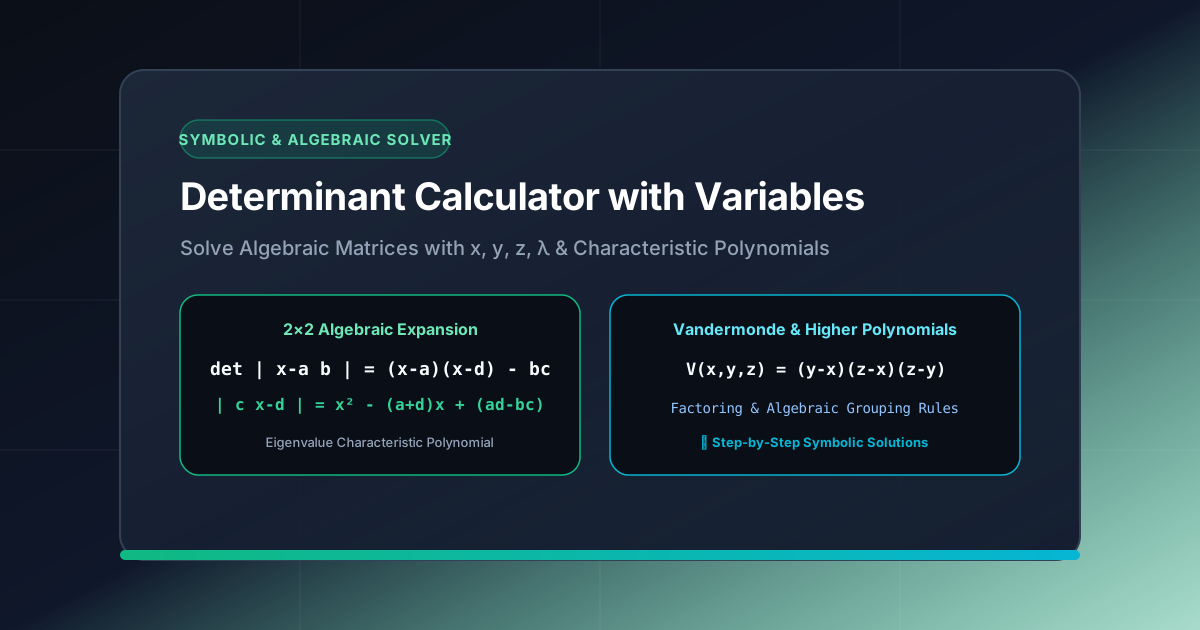
Direct Answer / AI Overview: A determinant calculator with variables computes the symbolic algebraic expression or polynomial resulting from a matrix containing variable entries (such as $x$, $y$, $z$, or $\lambda$). For a $2\times 2$ matrix $\begin{bmatrix} x - a & b \ c & x - d \end{bmatrix}$, the determinant is evaluated symbolically as $(x-a)(x-d) - bc = x^2 - (a+d)x + (ad-bc)$. For $3\times 3$ symbolic matrices, Laplace cofactor expansion or algebraic grouping is used to produce characteristic polynomials.
While standard numerical calculators only evaluate matrices with fixed numbers, advanced linear algebra and physics problems frequently require calculating determinants of matrices containing algebraic variables. These symbolic determinants are fundamental for:
- Eigenvalue Computation: Solving the characteristic equation $\det(A - \lambda I) = 0$.
- Cramer’s Rule with Unknowns: Expressing solutions as functions of system parameters.
- Multivariable Calculus & Jacobians: Computing transformation scaling factors involving $x, y, z$.
- Vandermonde Matrices: Polynomial interpolation and curve fitting.
In this guide, we walk through how to solve $2\times 2$ and $3\times 3$ determinants with variables step-by-step, with algebraic proofs and factoring techniques.
1. 2x2 Determinant with Variables
The fundamental cross-multiplication formula remains $\det(A) = ad - bc$, but intermediate terms involve polynomial multiplication and distribution.
General 2x2 Variable Formula
$$\det \begin{bmatrix} f(x) & g(x) \ h(x) & k(x) \end{bmatrix} = [f(x) \cdot k(x)] - [g(x) \cdot h(x)]$$
Worked Example 1: Linear Variable Entries
Find the determinant of matrix $A$:
$$A = \begin{bmatrix} x + 3 & 2 \ 5 & x - 1 \end{bmatrix}$$
- Cross-multiply diagonal elements: $$(x + 3)(x - 1) = x^2 - x + 3x - 3 = x^2 + 2x - 3$$
- Cross-multiply off-diagonal elements: $$2 \times 5 = 10$$
- Subtract the off-diagonal product: $$\det(A) = (x^2 + 2x - 3) - 10 = x^2 + 2x - 13$$
If the question asks for which values of $x$ matrix $A$ is singular ($\det(A) = 0$), solve the quadratic equation using the quadratic formula: $$x = \frac{-2 \pm \sqrt{4 - 4(1)(-13)}}{2} = \frac{-2 \pm \sqrt{56}}{2} = -1 \pm \sqrt{14}$$
2. Characteristic Polynomial: Determinant with $\lambda$
Finding the eigenvalues of a matrix requires setting up the symbolic matrix $A - \lambda I$ and evaluating its determinant.
Worked Example 2: Finding $\det(A - \lambda I)$
Let matrix $B = \begin{bmatrix} 4 & 2 \ 1 & 3 \end{bmatrix}$. Subtract $\lambda$ along the main diagonal:
$$B - \lambda I = \begin{bmatrix} 4 - \lambda & 2 \ 1 & 3 - \lambda \end{bmatrix}$$
- Expand the determinant: $$\det(B - \lambda I) = (4 - \lambda)(3 - \lambda) - (2 \times 1)$$
- Multiply binomials: $$(4 - \lambda)(3 - \lambda) = 12 - 4\lambda - 3\lambda + \lambda^2 = \lambda^2 - 7\lambda + 12$$
- Subtract the scalar cross-product: $$\det(B - \lambda I) = \lambda^2 - 7\lambda + 12 - 2 = \lambda^2 - 7\lambda + 10$$
- Factor the polynomial: $$(\lambda - 5)(\lambda - 2) = 0 \implies \lambda_1 = 5, \quad \lambda_2 = 2$$
Learn more about characteristic equations in our Eigenvalues and Determinants Guide.
3. 3x3 Determinant with Multiple Variables
For $3\times 3$ matrices with variables, use Laplace expansion along the row or column with the simplest algebraic expressions or maximum zeros.
Worked Example 3: 3x3 Matrix with $x, y, z$
Evaluate the determinant of matrix $C$:
$$C = \begin{bmatrix} x & y & z \ 0 & x & y \ 0 & 0 & x \end{bmatrix}$$
Since matrix $C$ is upper triangular (all entries below the main diagonal are zero), its determinant is simply the product of its diagonal entries:
$$\det(C) = x \cdot x \cdot x = x^3$$
Now consider a non-triangular variable matrix:
$$D = \begin{bmatrix} 1 & x & x^2 \ 1 & y & y^2 \ 1 & z & z^2 \end{bmatrix}$$
This is the famous $3\times 3$ Vandermonde Determinant. Expanding by minors:
- Expand along Row 1: $$\det(D) = 1(yz^2 - zy^2) - x(z^2 - y^2) + x^2(z - y)$$
- Factor common terms $(z - y)$: $$\det(D) = (z - y)[yz - x(z + y) + x^2]$$ $$\det(D) = (z - y)[yz - xz - xy + x^2]$$
- Group by factoring: $$\det(D) = (z - y)[z(y - x) - x(y - x)] = (z - y)(y - x)(z - x)$$
This clean product identity $(y-x)(z-x)(z-y)$ proves that the determinant is zero if and only if any two variables are equal ($x=y$, $y=z$, or $x=z$).
Key Algebraic Rules for Determinants with Variables
| Property | Algebraic Rule | Practical Impact |
|---|---|---|
| Factoring a Constant/Variable | $\det(\text{Row } i \cdot x) = x \cdot \det(A)$ | Pull common variable factors out of any single row or column |
| Zero Determinant Condition | $\det(A(x)) = 0$ | Roots of the polynomial represent singular configurations |
| Product Rule | $\det(A(x)B(x)) = \det(A(x))\det(B(x))$ | Multiply determinants before expanding complex matrices |
| Transpose | $\det(A(x)^T) = \det(A(x))$ | Row expansion = Column expansion |
Common Mistakes When Calculating Determinants with Variables
- Sign Errors with Negatives: Forgetting parentheses when subtracting binomials:
- Incorrect: $x^2 + 2x - 3 - 2 \cdot 5 = x^2 + 2x - 3 - 10$ is correct, but $- (2x - 5) \neq -2x - 5$. Always write $- (2x - 5) = -2x + 5$.
- Incorrect Alternating Signs in 3x3 Expansion: The cofactor sign pattern is always: $$\begin{bmatrix} + & - & + \ - & + & - \ + & - & + \end{bmatrix}$$
- Confusing Scalar Multiplication: For an $n\times n$ matrix, $\det(x A) = x^n \det(A)$, NOT $x \det(A)$.
Frequently Asked Questions (FAQ)
Can an online determinant calculator solve matrices with variables?
Most standard numeric calculators only accept numbers. For numeric matrix evaluation with customizable precision, use our Determinant Solver. For variable matrices, you expand polynomials manually using Laplace minors or symbolic algebra software (like SymPy or Mathematica).
What is a determinant with variables called?
A determinant with variables is known as a symbolic determinant or algebraic determinant. When derived from $A - \lambda I$, it is called the characteristic polynomial.
How do you find the values of x that make a determinant zero?
To find values of $x$ where $\det(A(x)) = 0$:
- Compute the symbolic determinant to get a polynomial $P(x)$.
- Set the polynomial equal to zero: $P(x) = 0$.
- Solve for the roots using factoring, the quadratic formula, or root-finding algorithms.
Need additional tools?
Explore our complete collection of SEO software, AI tools, calculators and converters.
Related Mathematical Resources
Essential matrix guides, determinant theorems, and computational tutorials
- • Reduced Row Echelon Form (RREF) – Master Gauss-Jordan row reduction, leading pivot rules, and understand why full rank RREF matrices guarantee non-zero determinants. reduced row echelon form RREF guide .
- • Matrix Multiplication & Determinants – Learn row-by-column multiplication algorithms and prove the fundamental product determinant theorem det(AB) = det(A)det(B). matrix multiplication determinant rule .
- • Solving 3 Equations 3 Unknowns – Solve 3-variable linear systems comparing matrix inversion AX=B, Cramer's rule determinant ratios, and Gaussian elimination. solving 3 equations 3 unknowns matrix method .
- • Which Matrix is Invertible? – Test if a matrix is invertible, identify singular matrices with determinant zero, and solve exam problems finding parameter k. singular matrix invertibility test .
- • LU Decomposition Method – Learn how partial pivoting and triangular factorization compute matrix determinants in O(n³) polynomial time with high numerical stability. LU decomposition determinant calculation .
- • Sarrus' Rule Shortcut – Master the visual diagonal method for rapid manual 3x3 matrix determinant evaluations without expansion errors. Sarrus rule for 3x3 determinants .
- • Cramer's Rule Guide – Step-by-step guide to solving simultaneous linear equations using coefficient matrix determinant ratios. Cramer's rule linear systems .
- • Step-by-Step Methods – Compare Laplace cofactor expansion, Gaussian row reduction, and triangular methods with complete worked proofs. determinant calculator with steps .
- • Matrix Inverses & Adjugates – Understand the relationship between non-zero determinants, invertible matrix theorems, and cofactor adjugates. matrix inverse adjugate method .