
Egenvärden och det karakteristiska polynomet: Förklaring av det(A - λI) = 0
Lär dig hur den karakteristiska ekvationen det(A - λI) = 0 beräknar egenvärden och egenvektorer i linjär algebra.
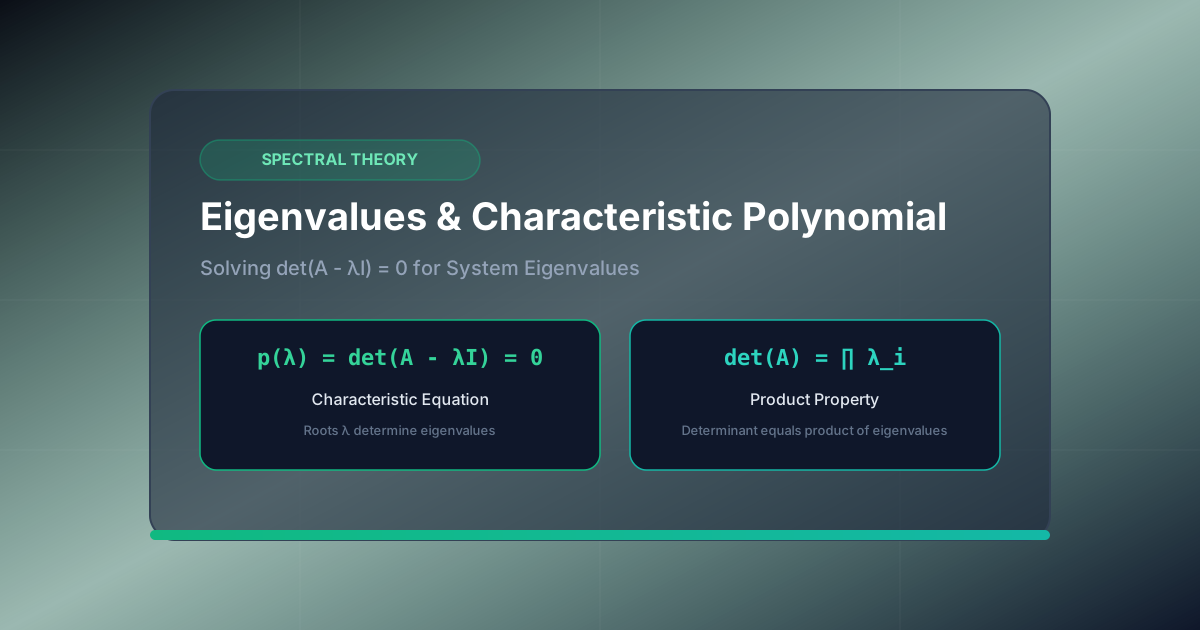
Direct Answer: Eigenvalues are scalar values $\lambda$ that satisfy the characteristic equation $\det(A - \lambda I) = 0$. Setting the matrix determinant of $(A - \lambda I)$ to zero guarantees that the matrix is singular according to the Invertible Matrix Theorem, allowing non-zero eigenvector solutions $v$ such that $Av = \lambda v$.
Eigenvalues and eigenvectors are fundamental pillars of linear algebra, quantum mechanics, principal component analysis (PCA), structural vibration analysis, and machine learning models.
At the center of eigenvalue calculation lies a crucial matrix expression: the characteristic polynomial, defined directly by a determinant:
$$\det(A - \lambda I) = 0$$
In this guide, we explore how matrix determinants are used to derive characteristic polynomials and solve for matrix eigenvalues.
What is an Eigenvalue?
For a square matrix $A$, a non-zero vector $v$ is called an eigenvector if multiplying $A$ by $v$ yields a scaled version of $v$:
$$A v = \lambda v$$
Where $\lambda$ is a scalar known as the eigenvalue.
Rearranging the equation:
$$(A - \lambda I) v = 0$$
For a non-zero eigenvector $v$ to exist, the matrix $(A - \lambda I)$ must be singular (non-invertible). According to the Invertible Matrix Theorem, a matrix is singular if and only if its determinant equals zero:
$$\det(A - \lambda I) = 0$$
This is known as the characteristic equation of matrix $A$.
Step-by-Step Example: Finding Eigenvalues of a 2x2 Matrix
Let’s calculate the eigenvalues for matrix $A$:
$$A = \begin{bmatrix} 4 & 2 \ 1 & 3 \end{bmatrix}$$
Step 1: Form $(A - \lambda I)$
$$A - \lambda I = \begin{bmatrix} 4 - \lambda & 2 \ 1 & 3 - \lambda \end{bmatrix}$$
Step 2: Compute $\det(A - \lambda I)$
$$\det(A - \lambda I) = (4 - \lambda)(3 - \lambda) - (2)(1)$$ $$= (12 - 7\lambda + \lambda^2) - 2$$ $$= \lambda^2 - 7\lambda + 10$$
Step 3: Solve the Characteristic Equation $\lambda^2 - 7\lambda + 10 = 0$
Factoring the quadratic equation: $$(\lambda - 5)(\lambda - 2) = 0$$
The eigenvalues of $A$ are: $$\lambda_1 = 5, \quad \lambda_2 = 2$$
Key Eigenvalue Properties Involving Determinants
- Product of Eigenvalues: The product of all eigenvalues of matrix $A$ equals the determinant of $A$, reflecting fundamental Matrix Determinant Properties: $$\det(A) = \prod_{i=1}^n \lambda_i$$
- Sum of Eigenvalues (Trace): The sum of all eigenvalues equals the trace of $A$ (sum of diagonal entries): $$\text{Tr}(A) = \sum_{i=1}^n \lambda_i$$
- Invertibility Check: If any eigenvalue $\lambda_i = 0$, then $\det(A) = 0$, proving $A$ is non-invertible.
- Spectral Applications: In physics, eigenvalues determine principal stresses and normal modes. Learn more in Applications of Determinants in Physics and Engineering.
Engineering & Scientific Applications of Eigenvalues
Characteristic equations and eigenvalue determinants form the mathematical core of modern engineering dynamics and data science:
- Structural Resonance: In mechanical and civil engineering, the roots of $\det(K - \omega^2 M) = 0$ define the natural resonance frequencies $\omega$ of buildings, bridges, and aircraft wings.
- Principal Component Analysis (PCA): In machine learning and statistics, finding the eigenvectors of a covariance matrix isolates principal orthogonal components of variance.
- Quantum Mechanics: Observable physical quantities correspond to eigenvalues of Hermitian operator matrices.
To experiment with matrix equations, test matrix invertibility, or compute determinants online, try our free interactive Determinant Solver or read our comprehensive guide on Matrix Inverses and the Adjugate Method.
Frequently Asked Questions (PAA)
Can a matrix have complex eigenvalues?
Yes! If a real matrix has a characteristic polynomial with complex roots, its eigenvalues occur in complex conjugate pairs.
What is the relationship between $\det(A)$ and eigenvalues?
The determinant of matrix $A$ equals the product of all its eigenvalues ($\det(A) = \lambda_1 \cdot \lambda_2 \cdots \lambda_n$). If $\det(A) = 0$, at least one eigenvalue must be zero.
What is the degree of the characteristic polynomial for an $n \times n$ matrix?
The characteristic polynomial of an $n \times n$ matrix is always an $n$-th degree polynomial in $\lambda$.
Related Linear Algebra Guides
- Matrix Diagonalization & Cholesky Decomposition: Fast Determinants
- Invertible Matrix Theorem & Determinants
- Matrix Determinant Properties Explained
- Real-World Applications in Physics & Engineering
Need additional tools?
Explore our complete collection of SEO software, AI tools, calculators and converters.
Related Mathematical Resources
Essential matrix guides, determinant theorems, and computational tutorials
- • Reduced Row Echelon Form (RREF) – Master Gauss-Jordan row reduction, leading pivot rules, and understand why full rank RREF matrices guarantee non-zero determinants. reduced row echelon form RREF guide .
- • Matrix Multiplication & Determinants – Learn row-by-column multiplication algorithms and prove the fundamental product determinant theorem det(AB) = det(A)det(B). matrix multiplication determinant rule .
- • Solving 3 Equations 3 Unknowns – Solve 3-variable linear systems comparing matrix inversion AX=B, Cramer's rule determinant ratios, and Gaussian elimination. solving 3 equations 3 unknowns matrix method .
- • Which Matrix is Invertible? – Test if a matrix is invertible, identify singular matrices with determinant zero, and solve exam problems finding parameter k. singular matrix invertibility test .
- • LU Decomposition Method – Learn how partial pivoting and triangular factorization compute matrix determinants in O(n³) polynomial time with high numerical stability. LU decomposition determinant calculation .
- • Sarrus' Rule Shortcut – Master the visual diagonal method for rapid manual 3x3 matrix determinant evaluations without expansion errors. Sarrus rule for 3x3 determinants .
- • Cramer's Rule Guide – Step-by-step guide to solving simultaneous linear equations using coefficient matrix determinant ratios. Cramer's rule linear systems .
- • Step-by-Step Methods – Compare Laplace cofactor expansion, Gaussian row reduction, and triangular methods with complete worked proofs. determinant calculator with steps .
- • Matrix Inverses & Adjugates – Understand the relationship between non-zero determinants, invertible matrix theorems, and cofactor adjugates. matrix inverse adjugate method .