Satsen om inverterbara matriser: Varför det(A) ≠ 0 avgör inverterbarhet
Förstå det grundläggande sambandet mellan icke-noll determinanter, inverterbarhet och linjärt oberoende.
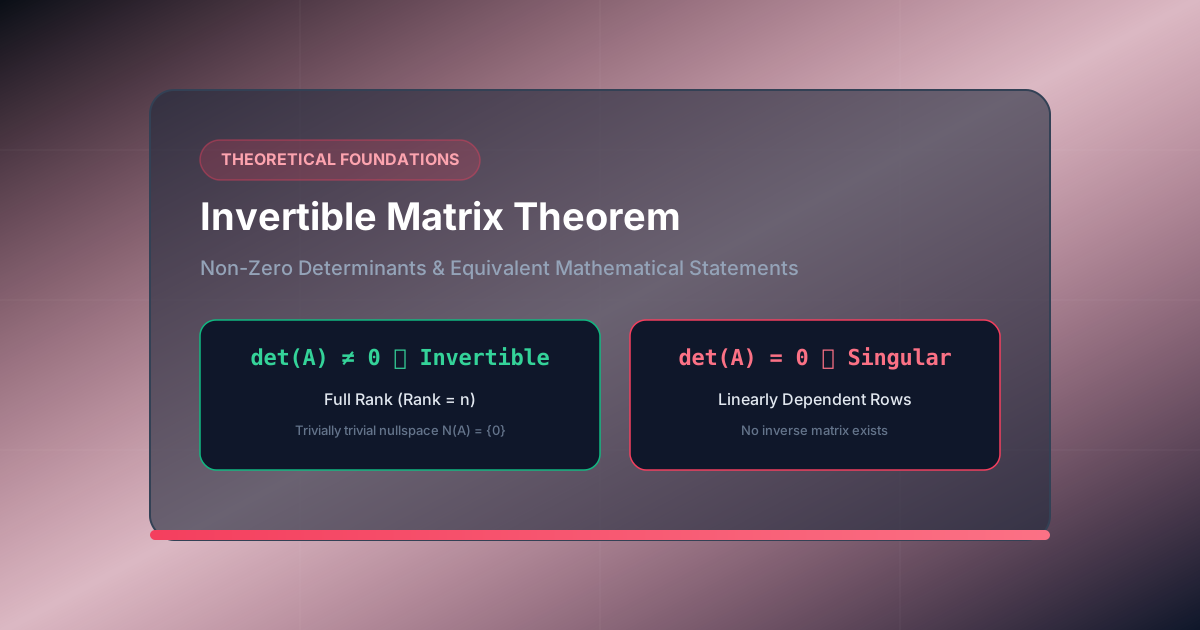
Direct Answer: The Invertible Matrix Theorem proves that for any square $n \times n$ matrix $A$, matrix invertibility ($A^{-1}$ exists) is logically equivalent to $\det(A) \neq 0$, full rank ($\text{Rank}(A) = n$), linear independence of rows/columns, non-zero eigenvalues ($\lambda_i \neq 0$), and unique solvability of $AX = B$.
The Invertible Matrix Theorem is one of the most powerful and unifying concepts in introductory linear algebra. It connects matrix inverse properties, system solvability, linear independence, rank, eigenvalues, and determinants into a single equivalent framework.
At the very heart of this theorem lies a simple condition: the determinant of the matrix must be non-zero ($\det(A) \neq 0$).
What is the Invertible Matrix Theorem?
For an $n \times n$ square matrix $A$, the following statements are logically equivalent. If any single statement is true, all other statements are guaranteed to be true!
- $A$ is an invertible matrix (there exists $A^{-1}$ such that $A A^{-1} = I$, computed via the Matrix Inverse Adjugate Method).
- $\det(A) \neq 0$ (the determinant is non-zero).
- The columns of $A$ form a linearly independent set.
- The rows of $A$ form a linearly independent set.
- $\text{Rank}(A) = n$ (full rank matrix).
- The system $AX = 0$ has only the trivial solution ($X = 0$).
- The system $AX = B$ has a unique solution for every vector $B$, solvable via Cramer’s Rule.
- $\lambda = 0$ is NOT an eigenvalue of $A$ (see our guide on Eigenvalues & Characteristic Polynomials).
- The transformation $T(x) = Ax$ is one-to-one and onto.
Why Is a Non-Zero Determinant Critical?
Geometrically, a matrix transformation maps the unit hypercube to a parallelotope whose volume equals $|\det(A)|$. For more on this, see Calculating Area and Volume Using Determinants.
- If $\det(A) \neq 0$, the spatial volume is preserved (scaled by $|\det(A)|$). The transformation does not collapse space, meaning every point can be uniquely mapped back (inverted).
- If $\det(A) = 0$, the matrix squashes space into a lower dimension (a line or a plane). Information is lost, making it impossible to invert the process.
Practical Applications in Software & Engineering
Testing matrix invertibility is a fundamental prerequisite in computational graphics, finite element analysis, machine learning models, and control systems. Fast numerical algorithms like LU Decomposition verify invertibility in $O(n^3)$ operations.
In computational algorithms, checking whether $\det(A) \neq 0$ ensures that coordinate mappings, graphic perspective transformations, and robotic kinematic chains are reversible. For systems with $\det(A) \approx 0$, condition number analysis identifies ill-conditioned systems prone to catastrophic floating-point precision loss.
To quickly verify if a matrix is invertible and calculate its exact scalar value, use our interactive Determinant Solver or explore how invertibility governs linear equations in our Cramer’s Rule Guide.
Frequently Asked Questions (PAA)
Can a non-square matrix be invertible?
No. By definition, matrix invertibility requires a square $n \times n$ matrix. Rectangular matrices may possess one-sided pseudo-inverses, but not true two-sided inverses.
What is the relationship between rank and determinant?
If an $n \times n$ matrix has $\det(A) \neq 0$, its rank is exactly $n$. If $\det(A) = 0$, its rank is strictly less than $n$.
How does the determinant indicate unique solutions for linear systems?
If $\det(A) \neq 0$, the linear system $AX = B$ has a single unique solution $X = A^{-1}B$. If $\det(A) = 0$, the system either has no solution (inconsistent) or infinitely many solutions (dependent).
Related Linear Algebra Guides
- Matrix Inverse Adjugate Method
- Cramer’s Rule: Solving Linear Systems
- Eigenvalues & Characteristic Polynomials
Need additional tools?
Explore our complete collection of SEO software, AI tools, calculators and converters.
Related Mathematical Resources
Essential matrix guides, determinant theorems, and computational tutorials
- • Reduced Row Echelon Form (RREF) – Master Gauss-Jordan row reduction, leading pivot rules, and understand why full rank RREF matrices guarantee non-zero determinants. reduced row echelon form RREF guide .
- • Matrix Multiplication & Determinants – Learn row-by-column multiplication algorithms and prove the fundamental product determinant theorem det(AB) = det(A)det(B). matrix multiplication determinant rule .
- • Solving 3 Equations 3 Unknowns – Solve 3-variable linear systems comparing matrix inversion AX=B, Cramer's rule determinant ratios, and Gaussian elimination. solving 3 equations 3 unknowns matrix method .
- • Which Matrix is Invertible? – Test if a matrix is invertible, identify singular matrices with determinant zero, and solve exam problems finding parameter k. singular matrix invertibility test .
- • LU Decomposition Method – Learn how partial pivoting and triangular factorization compute matrix determinants in O(n³) polynomial time with high numerical stability. LU decomposition determinant calculation .
- • Sarrus' Rule Shortcut – Master the visual diagonal method for rapid manual 3x3 matrix determinant evaluations without expansion errors. Sarrus rule for 3x3 determinants .
- • Cramer's Rule Guide – Step-by-step guide to solving simultaneous linear equations using coefficient matrix determinant ratios. Cramer's rule linear systems .
- • Step-by-Step Methods – Compare Laplace cofactor expansion, Gaussian row reduction, and triangular methods with complete worked proofs. determinant calculator with steps .
- • Matrix Inverses & Adjugates – Understand the relationship between non-zero determinants, invertible matrix theorems, and cofactor adjugates. matrix inverse adjugate method .