
10 основни свойства на детерминантите на матрици: Теоретично ръководство
Разгледайте фундаменталните свойства на детерминантите: мултипликативност det(AB)=det(A)det(B), транспониране и редови смени.
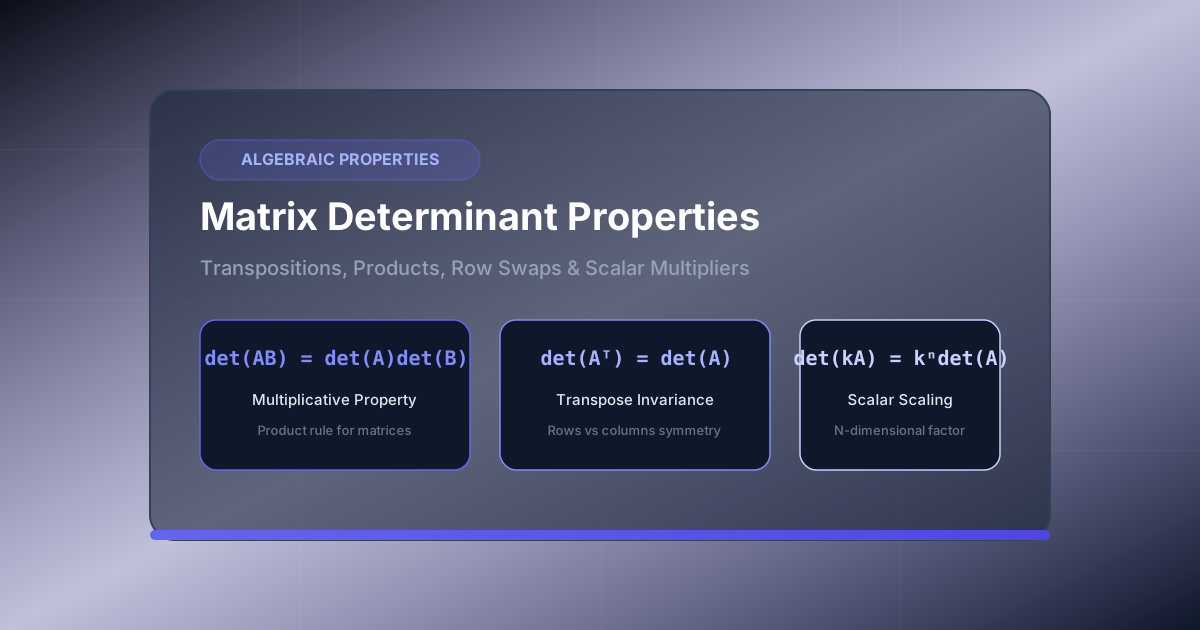
Direct Answer: Matrix determinant properties govern algebraic manipulation: $\det(A^T) = \det(A)$, $\det(AB) = \det(A)\det(B)$, $\det(kA) = k^n \det(A)$, $\det(A^{-1}) = 1/\det(A)$, and row swaps flip the determinant sign ($\det(B) = -\det(A)$). Adding a row multiple leaves the determinant unchanged.
Matrix determinants possess distinct algebraic properties that simplify complex linear algebra computations. Understanding these fundamental rules allows students, engineers, and data scientists to evaluate determinants quickly without brute-force cofactor expansions.
In this guide, we review the top 10 core properties of matrix determinants with clear mathematical proofs and practical insights.
1. Determinant of Transpose Matrix
The determinant of a matrix equals the determinant of its transpose: $$\det(A^T) = \det(A)$$
2. Row Swap Property (Sign Flip)
Swapping any two rows or two columns of a square matrix flips the sign of the determinant: $$\text{If } B \text{ is formed by swapping two rows of } A, \text{ then } \det(B) = -\det(A)$$
3. Row Scaling Property
If a single row or column of a matrix is multiplied by a scalar $k$, the determinant is multiplied by $k$: $$\det(R_i \to k \cdot R_i) = k \cdot \det(A)$$
4. Full Matrix Scalar Multiplication
For an $n \times n$ matrix $A$ scaled by a scalar $k$: $$\det(k A) = k^n \cdot \det(A)$$
5. Row Addition Property (Elementary Row Operations)
Adding a multiple of one row to another row does not change the determinant: $$\det(R_i \to R_i + k R_j) = \det(A)$$ This is the core foundation of Gaussian elimination and high-speed algorithm design in LU Decomposition for Determinants.
6. Matrix Product Property
The determinant of the product of two square matrices equals the product of their determinants: $$\det(A B) = \det(A) \cdot \det(B)$$
7. Zero Determinant Conditions (Singular Matrix)
The determinant of a matrix is zero ($\det(A) = 0$) if:
- Any row or column consists entirely of zeros.
- Two rows or two columns are identical.
- Two rows or two columns are linearly dependent according to the Invertible Matrix Theorem.
8. Determinant of Identity Matrix
The determinant of an identity matrix of any size $n \times n$ is always 1: $$\det(I_n) = 1$$
9. Determinant of Triangular Matrix
For an upper triangular, lower triangular, or diagonal matrix, the determinant is simply the product of its main diagonal elements: $$\det(A) = a_{11} \cdot a_{22} \dots a_{nn}$$
10. Inverse Matrix Determinant
If matrix $A$ is invertible ($\det(A) \neq 0$), the determinant of its inverse is the reciprocal of $\det(A)$, as used in the Matrix Inverse Adjugate Method: $$\det(A^{-1}) = \frac{1}{\det(A)}$$
Computational & Engineering Applications
These algebraic properties are essential across science, computer graphics, and engineering. From solving structural balance equations to calculating change-of-variable volume factors in vector calculus, leveraging determinant theorems simplifies complex analyses.
Understanding that $\det(AB) = \det(A)\det(B)$ allows computer graphics pipelines to concatenate multiple translation, rotation, and scaling matrices while precomputing total volume scaling with zero redundant arithmetic.
To experiment with these matrix properties in real time, enter custom matrices into our free Determinant Solver or see how determinants relate to eigenvalues in our Eigenvalues and Determinants Guide.
Frequently Asked Questions (PAA)
Does $\det(A + B) = \det(A) + \det(B)$?
No! Determinants are non-linear operators. In general, $\det(A + B) \neq \det(A) + \det(B)$.
Why does swapping two rows flip the sign?
The determinant function is an alternating multilinear form. Swapping two vectors in an alternating tensor switches orientation, introducing a $-1$ multiplier.
How do eigenvalues relate to matrix determinant properties?
The product of all matrix eigenvalues $\lambda_i$ equals the matrix determinant ($\det(A) = \prod \lambda_i$). See our guide on Eigenvalues & Characteristic Polynomials.
Related Linear Algebra Guides
- LU Decomposition for Determinant Calculation
- Invertible Matrix Theorem & Determinants
- Matrix Inverse Adjugate Method
Need additional tools?
Explore our complete collection of SEO software, AI tools, calculators and converters.
Related Mathematical Resources
Essential matrix guides, determinant theorems, and computational tutorials
- • Reduced Row Echelon Form (RREF) – Master Gauss-Jordan row reduction, leading pivot rules, and understand why full rank RREF matrices guarantee non-zero determinants. reduced row echelon form RREF guide .
- • Matrix Multiplication & Determinants – Learn row-by-column multiplication algorithms and prove the fundamental product determinant theorem det(AB) = det(A)det(B). matrix multiplication determinant rule .
- • Solving 3 Equations 3 Unknowns – Solve 3-variable linear systems comparing matrix inversion AX=B, Cramer's rule determinant ratios, and Gaussian elimination. solving 3 equations 3 unknowns matrix method .
- • Which Matrix is Invertible? – Test if a matrix is invertible, identify singular matrices with determinant zero, and solve exam problems finding parameter k. singular matrix invertibility test .
- • LU Decomposition Method – Learn how partial pivoting and triangular factorization compute matrix determinants in O(n³) polynomial time with high numerical stability. LU decomposition determinant calculation .
- • Sarrus' Rule Shortcut – Master the visual diagonal method for rapid manual 3x3 matrix determinant evaluations without expansion errors. Sarrus rule for 3x3 determinants .
- • Cramer's Rule Guide – Step-by-step guide to solving simultaneous linear equations using coefficient matrix determinant ratios. Cramer's rule linear systems .
- • Step-by-Step Methods – Compare Laplace cofactor expansion, Gaussian row reduction, and triangular methods with complete worked proofs. determinant calculator with steps .
- • Matrix Inverses & Adjugates – Understand the relationship between non-zero determinants, invertible matrix theorems, and cofactor adjugates. matrix inverse adjugate method .