एडज्युगेट और डिटरमिनेंट द्वारा मैट्रिक्स व्युत्क्रम: A⁻¹ = adj(A)/det(A) सूत्र
एडज्युगेट मैट्रिक्स और डिटरमिनेंट सूत्र का उपयोग करके 2x2 और 3x3 मैट्रिक्स का व्युत्क्रम निकालना सीखें।
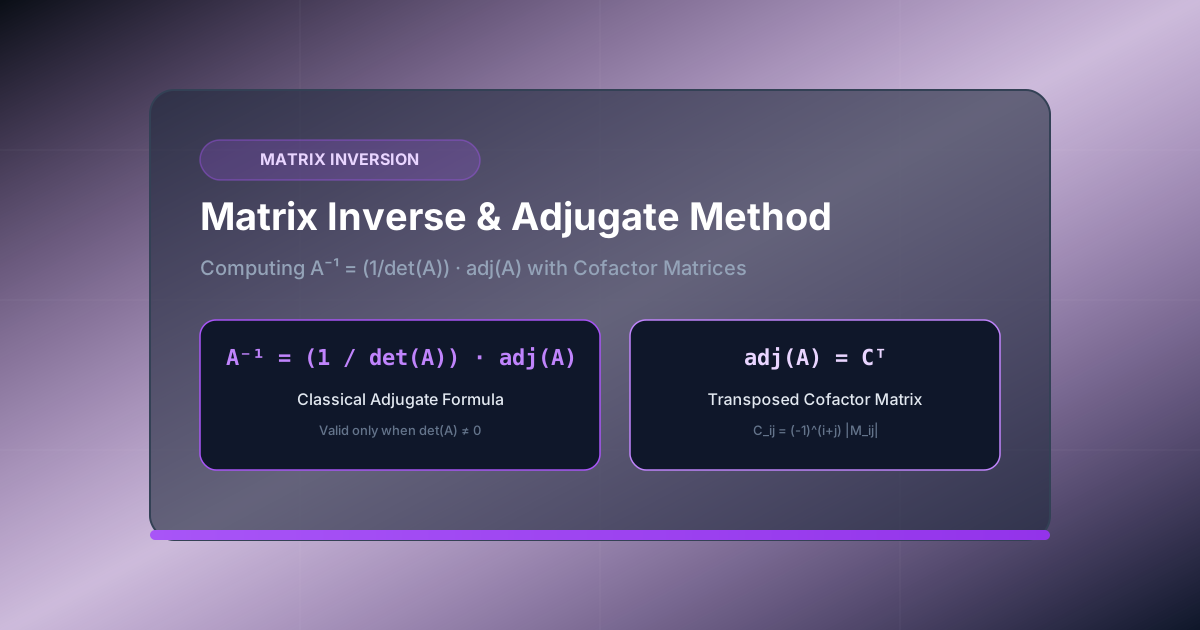
Direct Answer: The inverse of a square matrix $A$ is calculated using the adjugate formula $A^{-1} = \frac{1}{\det(A)} \text{adj}(A)$, where $\text{adj}(A)$ is the transpose of the cofactor matrix $C^T$. The inverse exists if and only if $\det(A) \neq 0$.
Finding the inverse of a matrix ($A^{-1}$) is one of the most fundamental operations in linear algebra. Among the various methods available—such as Gauss-Jordan elimination and LU Decomposition—the Adjugate (Adjoint) and Determinant Method provides a direct explicit formula for computing matrix inverses.
In this guide, we explore the formula $A^{-1} = \frac{1}{\det(A)} \text{adj}(A)$, walk through step-by-step 2x2 and 3x3 worked examples, and explain when to apply it.
The Inverse Formula
For any square matrix $A$ where $\det(A) \neq 0$ (verified by the Invertible Matrix Theorem), its inverse is given by:
$$A^{-1} = \frac{1}{\det(A)} \text{adj}(A)$$
Where:
- $\det(A)$ is the scalar determinant of $A$.
- $\text{adj}(A)$ is the adjugate matrix, which is the transpose of the cofactor matrix $C$: $$\text{adj}(A) = C^T$$
1. Finding the Inverse of a 2x2 Matrix
For a 2x2 matrix $A$:
$$A = \begin{bmatrix} a & b \ c & d \end{bmatrix}$$
- Calculate the determinant: $$\det(A) = ad - bc$$
- Form the adjugate matrix (swap main diagonal entries $a$ and $d$, flip signs of off-diagonal entries $b$ and $c$): $$\text{adj}(A) = \begin{bmatrix} d & -b \ -c & a \end{bmatrix}$$
- Multiply by $\frac{1}{\det(A)}$: $$A^{-1} = \frac{1}{ad - bc} \begin{bmatrix} d & -b \ -c & a \end{bmatrix}$$
2. Finding the Inverse of a 3x3 Matrix: Step-by-Step
Let’s find the inverse of matrix $M$:
$$M = \begin{bmatrix} 1 & 0 & 2 \ 2 & -1 & 3 \ 4 & 1 & 8 \end{bmatrix}$$
Step 1: Calculate $\det(M)$
Using minor expansion (see How to Find 3x3 Determinant Step by Step):
$$\det(M) = 1((-1)(8) - (3)(1)) - 0 + 2((2)(1) - (-1)(4))$$ $$= 1(-8 - 3) + 2(2 + 4) = -11 + 12 = 1$$
Since $\det(M) = 1 \neq 0$, the inverse exists!
Step 2: Compute the Cofactor Matrix $C$
For each element $m_{ij}$, the cofactor is $C_{ij} = (-1)^{i+j} M_{ij}$:
$$C = \begin{bmatrix} \begin{vmatrix} -1 & 3 \ 1 & 8 \end{vmatrix} & -\begin{vmatrix} 2 & 3 \ 4 & 8 \end{vmatrix} & \begin{vmatrix} 2 & -1 \ 4 & 1 \end{vmatrix} \[1em] -\begin{vmatrix} 0 & 2 \ 1 & 8 \end{vmatrix} & \begin{vmatrix} 1 & 2 \ 4 & 8 \end{vmatrix} & -\begin{vmatrix} 1 & 0 \ 4 & 1 \end{vmatrix} \[1em] \begin{vmatrix} 0 & 2 \ -1 & 3 \end{vmatrix} & -\begin{vmatrix} 1 & 2 \ 2 & 3 \end{vmatrix} & \begin{vmatrix} 1 & 0 \ 2 & -1 \end{vmatrix} \end{bmatrix}$$
Evaluating each 2x2 determinant:
$$C = \begin{bmatrix} -11 & -4 & 6 \ 2 & 0 & -1 \ 2 & 1 & -1 \end{bmatrix}$$
Step 3: Transpose $C$ to get $\text{adj}(M)$
$$\text{adj}(M) = C^T = \begin{bmatrix} -11 & 2 & 2 \ -4 & 0 & 1 \ 6 & -1 & -1 \end{bmatrix}$$
Step 4: Multiply by $\frac{1}{\det(M)}$
Since $\det(M) = 1$:
$$M^{-1} = \begin{bmatrix} -11 & 2 & 2 \ -4 & 0 & 1 \ 6 & -1 & -1 \end{bmatrix}$$
Numerical Efficiency: Adjugate Formula vs. Row Reduction
While the classical adjugate formula $A^{-1} = \frac{1}{\det(A)}\text{adj}(A)$ provides exact analytical formulas for $2\times 2$ and $3\times 3$ symbolic systems, it becomes computationally prohibitive for higher orders because an $n \times n$ matrix requires calculating $n^2$ separate $(n-1) \times (n-1)$ sub-determinants.
In scientific software and numerical libraries, Gauss-Jordan elimination with row augmentation $[A \mid I] \to [I \mid A^{-1}]$ or LU Decomposition with Partial Pivoting are universally preferred for computing matrix inverses in $O(n^3)$ operations.
To compute determinants and check matrix invertibility without algebraic errors, use our free online Determinant Solver or review determinant behavior in our Matrix Determinant Properties Guide.
Frequently Asked Questions (PAA)
What happens if $\det(A) = 0$?
If $\det(A) = 0$, division by zero is undefined ($\frac{1}{0}$). The matrix is singular and does not have an inverse according to the Invertible Matrix Theorem.
Is the adjugate method efficient for 5x5 matrices?
No. Computing the adjugate of a 5x5 matrix requires computing 25 separate 4x4 determinants. For 4x4 matrices and larger, Gauss-Jordan elimination or LU Decomposition is far more efficient.
What is the determinant of $A^{-1}$?
By Matrix Determinant Properties, $\det(A^{-1}) = \frac{1}{\det(A)}$.
Related Linear Algebra Guides
- Which Matrix is Invertible? Singular Matrix Test & det = 0
- Matrix Multiplication Properties & Product Determinant Theorem
- Invertible Matrix Theorem & Determinants
- How to Find the Determinant of a 3x3 Matrix
- Cramer’s Rule: Solving Linear Systems
Need additional tools?
Explore our complete collection of SEO software, AI tools, calculators and converters.
Related Mathematical Resources
Essential matrix guides, determinant theorems, and computational tutorials
- • Reduced Row Echelon Form (RREF) – Master Gauss-Jordan row reduction, leading pivot rules, and understand why full rank RREF matrices guarantee non-zero determinants. reduced row echelon form RREF guide .
- • Matrix Multiplication & Determinants – Learn row-by-column multiplication algorithms and prove the fundamental product determinant theorem det(AB) = det(A)det(B). matrix multiplication determinant rule .
- • Solving 3 Equations 3 Unknowns – Solve 3-variable linear systems comparing matrix inversion AX=B, Cramer's rule determinant ratios, and Gaussian elimination. solving 3 equations 3 unknowns matrix method .
- • Which Matrix is Invertible? – Test if a matrix is invertible, identify singular matrices with determinant zero, and solve exam problems finding parameter k. singular matrix invertibility test .
- • LU Decomposition Method – Learn how partial pivoting and triangular factorization compute matrix determinants in O(n³) polynomial time with high numerical stability. LU decomposition determinant calculation .
- • Sarrus' Rule Shortcut – Master the visual diagonal method for rapid manual 3x3 matrix determinant evaluations without expansion errors. Sarrus rule for 3x3 determinants .
- • Cramer's Rule Guide – Step-by-step guide to solving simultaneous linear equations using coefficient matrix determinant ratios. Cramer's rule linear systems .
- • Step-by-Step Methods – Compare Laplace cofactor expansion, Gaussian row reduction, and triangular methods with complete worked proofs. determinant calculator with steps .
- • Matrix Inverses & Adjugates – Understand the relationship between non-zero determinants, invertible matrix theorems, and cofactor adjugates. matrix inverse adjugate method .