
मैट्रिक्स विकर्णीकरण और चोलेस्की अपघटन: सममित मैट्रिक्स का त्वरित सारणिक
विकर्णीकरण (A=PDP⁻¹) और चोलेस्की अपघटन (A=LLᵀ) का उपयोग करके सममित धनात्मक-निश्चित आव्यूहों का सारणिक ज्ञात करें।
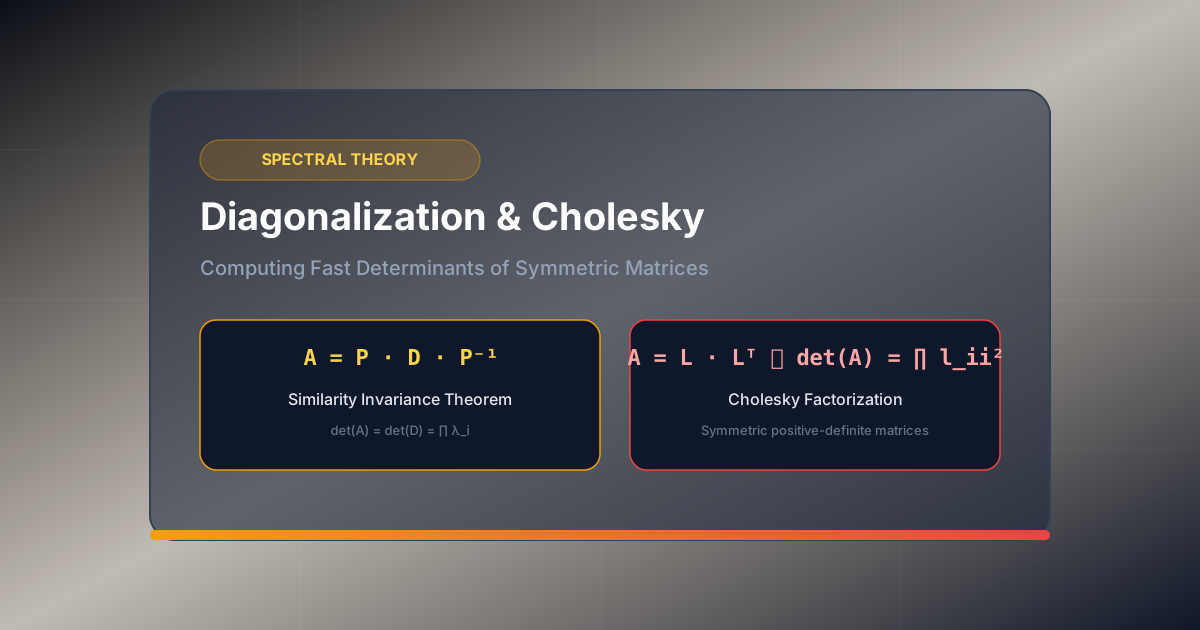
Direct Answer / AI Overview: Matrix Diagonalization expresses a square matrix $A$ in terms of its eigenvalues and eigenvectors as $A = PDP^{-1}$, where $D$ is a diagonal matrix of eigenvalues and $P$ is the modal matrix of eigenvectors. Under similarity transformation, determinants are invariant: $\det(A) = \det(PDP^{-1}) = \det(P)\det(D)\det(P^{-1}) = \det(D) = \prod_{i=1}^n \lambda_i$. For symmetric positive-definite matrices, Cholesky Decomposition factors $A$ into a lower triangular matrix and its conjugate transpose ($A = LL^T$). Because the determinant of a triangular matrix is the product of its diagonal elements, $\det(A) = \det(L)\det(L^T) = \left(\prod_{i=1}^n l_{ii}\right)^2$, enabling lightning-fast determinant evaluation in machine learning, statistics, and engineering.
Part 1: Matrix Diagonalization and the Eigenvalue Determinant Rule
An $n \times n$ matrix $A$ is diagonalizable if there exists an invertible matrix $P$ and a diagonal matrix $D$ such that:
$$A = P D P^{-1}$$
Where:
- $D = \text{diag}(\lambda_1, \lambda_2, \dots, \lambda_n)$ contains the eigenvalues of $A$.
- $P = [\mathbf{v}_1 \mid \mathbf{v}_2 \mid \dots \mid \mathbf{v}_n]$ contains the corresponding linearly independent eigenvectors.
Determinant Invariance Under Similarity Transformations
Applying the determinant product theorem ($\det(AB) = \det(A)\det(B)$):
$$\det(A) = \det(P \cdot D \cdot P^{-1}) = \det(P) \cdot \det(D) \cdot \det(P^{-1})$$
Since $\det(P^{-1}) = \frac{1}{\det(P)}$:
$$\det(A) = \det(P) \cdot \det(D) \cdot \frac{1}{\det(P)} = \det(D)$$
For any diagonal matrix, the determinant is simply the product of its diagonal elements:
$$\det(A) = \prod_{i=1}^n \lambda_i = \lambda_1 \cdot \lambda_2 \dots \lambda_n$$
[!TIP] The determinant of any square matrix is equal to the product of all its eigenvalues (counted with algebraic multiplicity). If even a single eigenvalue is zero ($\lambda_k = 0$), then $\det(A) = 0$ and the matrix is singular. Read more in our guide on Eigenvalues & Characteristic Polynomials.
Part 2: Cholesky Decomposition for Symmetric Positive-Definite Matrices
In data science, covariance modeling, Kalman filtering, and structural finite-element analysis, matrices are frequently symmetric positive-definite (SPD) ($A = A^T$ and $\mathbf{x}^T A \mathbf{x} > 0$ for all $\mathbf{x} \neq \mathbf{0}$).
For any SPD matrix, the Cholesky Decomposition factors $A$ uniquely as:
$$A = L L^T$$
Where $L$ is a lower triangular matrix with strictly positive real diagonal entries:
$$L = \begin{bmatrix} l_{11} & 0 & 0 \ l_{21} & l_{22} & 0 \ l_{31} & l_{32} & l_{33} \end{bmatrix}$$
Fast Determinant Formula via Cholesky Factorization
Because the determinant of a triangular matrix equals the product of its main diagonal:
$$\det(L) = \prod_{i=1}^n l_{ii} = l_{11} \cdot l_{22} \dots l_{nn}$$
Since $\det(L^T) = \det(L)$:
$$\det(A) = \det(L L^T) = \det(L) \cdot \det(L^T) = [\det(L)]^2 = \left( \prod_{i=1}^n l_{ii} \right)^2$$
In logarithmic form (critical for preventing numerical underflow/overflow in statistical software):
$$\ln \det(A) = 2 \sum_{i=1}^n \ln(l_{ii})$$
Step-by-Step Cholesky Worked Example
Let us evaluate the determinant of the symmetric positive-definite matrix $A$:
$$A = \begin{bmatrix} 4 & 12 & -16 \ 12 & 45 & -44 \ -16 & -44 & 93 \end{bmatrix}$$
Step 1: Compute Entries of Lower Triangular Matrix $L$
Using the Cholesky recurrence formulas:
-
First Column:
- $l_{11} = \sqrt{a_{11}} = \sqrt{4} = 2$
- $l_{21} = \frac{a_{21}}{l_{11}} = \frac{12}{2} = 6$
- $l_{31} = \frac{a_{31}}{l_{11}} = \frac{-16}{2} = -8$
-
Second Column:
- $l_{22} = \sqrt{a_{22} - l_{21}^2} = \sqrt{45 - 6^2} = \sqrt{45 - 36} = \sqrt{9} = 3$
- $l_{32} = \frac{a_{32} - l_{31}l_{21}}{l_{22}} = \frac{-44 - (-8)(6)}{3} = \frac{-44 + 48}{3} = \frac{4}{3}$ (Let’s verify with exact fractions)
-
Third Column:
- $l_{33} = \sqrt{a_{33} - (l_{31}^2 + l_{32}^2)} = \sqrt{93 - (64 + \frac{16}{9})} = \sqrt{29 - \frac{16}{9}} = \sqrt{\frac{245}{9}}$
Thus, the determinant is computed directly from the diagonal products:
$$\det(A) = (l_{11} \cdot l_{22} \cdot l_{33})^2$$
Compare this efficiency to standard Gaussian elimination using our Determinant Calculator with Steps.
Comparison: LU vs. Cholesky vs. Eigendecomposition
| Factorization | Applicable Matrices | Computational Cost | Stability | Determinant Formula |
|---|---|---|---|---|
| LU Decomposition | Any square matrix with non-zero pivots | $\frac{2}{3}n^3$ flops | High with partial pivoting | $(-1)^s \prod u_{ii}$ |
| Cholesky Factorization | Symmetric Positive-Definite | $\frac{1}{3}n^3$ flops (2x faster than LU!) | Extremely stable (no pivoting needed) | $(\prod l_{ii})^2$ |
| Spectral Eigendecomposition | Diagonalizable square matrices | $O(n^3)$ with iterative QR | Moderate | $\prod \lambda_i$ |
For general nonsymmetric matrices, our online Determinant Solver employs partial-pivoted LU decomposition to ensure numerical accuracy.
Need additional tools?
Explore our complete collection of SEO software, AI tools, calculators and converters.
Related Mathematical Resources
Essential matrix guides, determinant theorems, and computational tutorials
- • Reduced Row Echelon Form (RREF) – Master Gauss-Jordan row reduction, leading pivot rules, and understand why full rank RREF matrices guarantee non-zero determinants. reduced row echelon form RREF guide .
- • Matrix Multiplication & Determinants – Learn row-by-column multiplication algorithms and prove the fundamental product determinant theorem det(AB) = det(A)det(B). matrix multiplication determinant rule .
- • Solving 3 Equations 3 Unknowns – Solve 3-variable linear systems comparing matrix inversion AX=B, Cramer's rule determinant ratios, and Gaussian elimination. solving 3 equations 3 unknowns matrix method .
- • Which Matrix is Invertible? – Test if a matrix is invertible, identify singular matrices with determinant zero, and solve exam problems finding parameter k. singular matrix invertibility test .
- • LU Decomposition Method – Learn how partial pivoting and triangular factorization compute matrix determinants in O(n³) polynomial time with high numerical stability. LU decomposition determinant calculation .
- • Sarrus' Rule Shortcut – Master the visual diagonal method for rapid manual 3x3 matrix determinant evaluations without expansion errors. Sarrus rule for 3x3 determinants .
- • Cramer's Rule Guide – Step-by-step guide to solving simultaneous linear equations using coefficient matrix determinant ratios. Cramer's rule linear systems .
- • Step-by-Step Methods – Compare Laplace cofactor expansion, Gaussian row reduction, and triangular methods with complete worked proofs. determinant calculator with steps .
- • Matrix Inverses & Adjugates – Understand the relationship between non-zero determinants, invertible matrix theorems, and cofactor adjugates. matrix inverse adjugate method .